
Intelligenceoriginal.com · Profile · September 22, 2026
P r o f i l e
The Man Who Would Not Fall
Andrey Melnichenko built one of Russia’s great industrial fortunes, owned the world’s largest sailing yacht, and spent fourteen years as a model citizen of Switzerland. Then, on his fiftieth birthday, in Tanzania, while watching a sunset, he read on his phone that the European Union had frozen everything he owned. Four years later, he is still standing — and, according to those who have spoken with him recently, he has spent the intervening time figuring out exactly what that means.
By the Intelligence Original Editorial Desk · September 22, 2026 · 22 min read
On the morning of March 7, 2022, Andrey Melnichenko woke up in Tanzania a billionaire. He was fifty years old that day — the birthday was the reason for the trip, a celebration arranged months in advance, his family gathered around him in a country that had nothing to do with anything happening in Europe. He picked up his phone. He read the news. The European Union, acting on an emergency basis three days after Russia’s tanks crossed into Ukraine, had placed him on its sanctions list. Asset freeze. Travel ban. His accounts at Swiss banks — accounts that had been open, undisturbed, for more than a decade — were now, in legal terms, untouchable.
“A perfect present for my fiftieth birthday,” he told the Swiss publication Weltwoche shortly afterward. “And also so symbolic.” He paused, apparently genuinely unsure whether the symbolism was intended or merely coincidental. He has spent much of the time since trying to determine the answer to that question — and, having tentatively settled it, deciding what to do with his conclusion.
This week, the European Union reached an agreement to lift those sanctions. Four and a half years after they were imposed, EU ambassadors voted — quietly, as part of a larger package renewing penalties on thousands of other Russians — to remove both Melnichenko and his fellow billionaire Mikhail Fridman from the list. The decision was not unanimous. France had pushed for it; several other member states had resisted. The meeting that produced the agreement was, by diplomatic accounts, uncomfortable. Melnichenko’s lawyers had been working toward this outcome for years, constructing an argument that the legal basis for his designation — that he had “particularly close ties” to Vladimir Putin — was, in their submission, technically insufficient.
The technical argument may be correct. The picture it paints of Andrey Melnichenko is considerably more complicated.
I. The Making of a Billionaire
From Gomel to Zug: The Education of a Russian Oligarch
Andrey Melnichenko was born on March 8, 1972, in Gomel, in what was then the Byelorussian Soviet Socialist Republic — now Belarus. His childhood coincided with the final, exhausted decades of Soviet power, the era of empty shop shelves and elaborate informal economies, of dachas obtained through connections and petrol obtained through knowing the right person at the right depot. He came of age in exactly the years — the late 1980s, the early 1990s — when the Soviet system’s collapse created the conditions that made billionaires possible.
He went to Moscow. He studied physics at Moscow State University. He dropped out before finishing his degree, which is the kind of biographical detail that reads differently depending on whether you are writing a hagiography or an indictment. He opened a currency exchange bureau in 1993, at a time when operating a currency exchange in Moscow required a specific combination of commercial instinct, tolerance for risk, and relationships with people it was probably better not to describe in detail in a bank licence application. He was twenty-one years old.
The currency exchange became MDM Bank, which became one of Russia’s significant private financial institutions. From banking he moved into industry — coal, specifically, through a company called SUEK, which accumulated assets across Russia’s vast eastern coal fields, and fertilisers, through EuroChem, which grew into one of the world’s largest producers of nitrogen and potash, with operations across Russia, Europe, and Kazakhstan, and with its international headquarters established, with some deliberateness, in the Swiss canton of Zug.
Zug was a choice, not merely a convenience. Melnichenko moved there with his wife Aleksandra — a Serbian-born former pop star who had performed as Sasha, of the Russian pop duo Mario and Sasha — in 2009, and he remained there for the next thirteen years, acquiring the texture of a resident: a taxpayer, a property owner, a man whose children attended local schools and whose neighbours did not find him remarkable. He became, in his own description and in the assessment of Swiss authorities who dealt with him, an exemplary resident. He paid his taxes. He did not attract attention. He was not, so far as anyone has established, involved in the money-laundering operations that periodically visited embarrassment on Switzerland’s financial system.
“For the past fourteen years I lived mainly in Switzerland. I worked there, paid taxes, brought companies there. I became a kind of outcast from everywhere, while trying to do the right thing.”
— Andrey Melnichenko, Financial Times, 2023
There was also the yacht. Two yachts, in fact, over the years — both designed by Philippe Starck, both singular in their ambition, both expressions of a taste for the extraordinary that was consistent with his fortune but sharply at odds with his otherwise low-key manner of occupying Switzerland. The sailing yacht A, commissioned in 2017, is 143 metres long, the largest sailing yacht in the world by displacement — a vessel so extraordinary in its construction that it required a shipyard in Germany to essentially invent new methods of manufacture. Its three masts stand 90 metres above the waterline. Its interior is described by those who have been aboard it as unlike any other space that exists on water or on land. It is beautiful in the way that very expensive, very unusual things are beautiful: not despite the excess but through it.
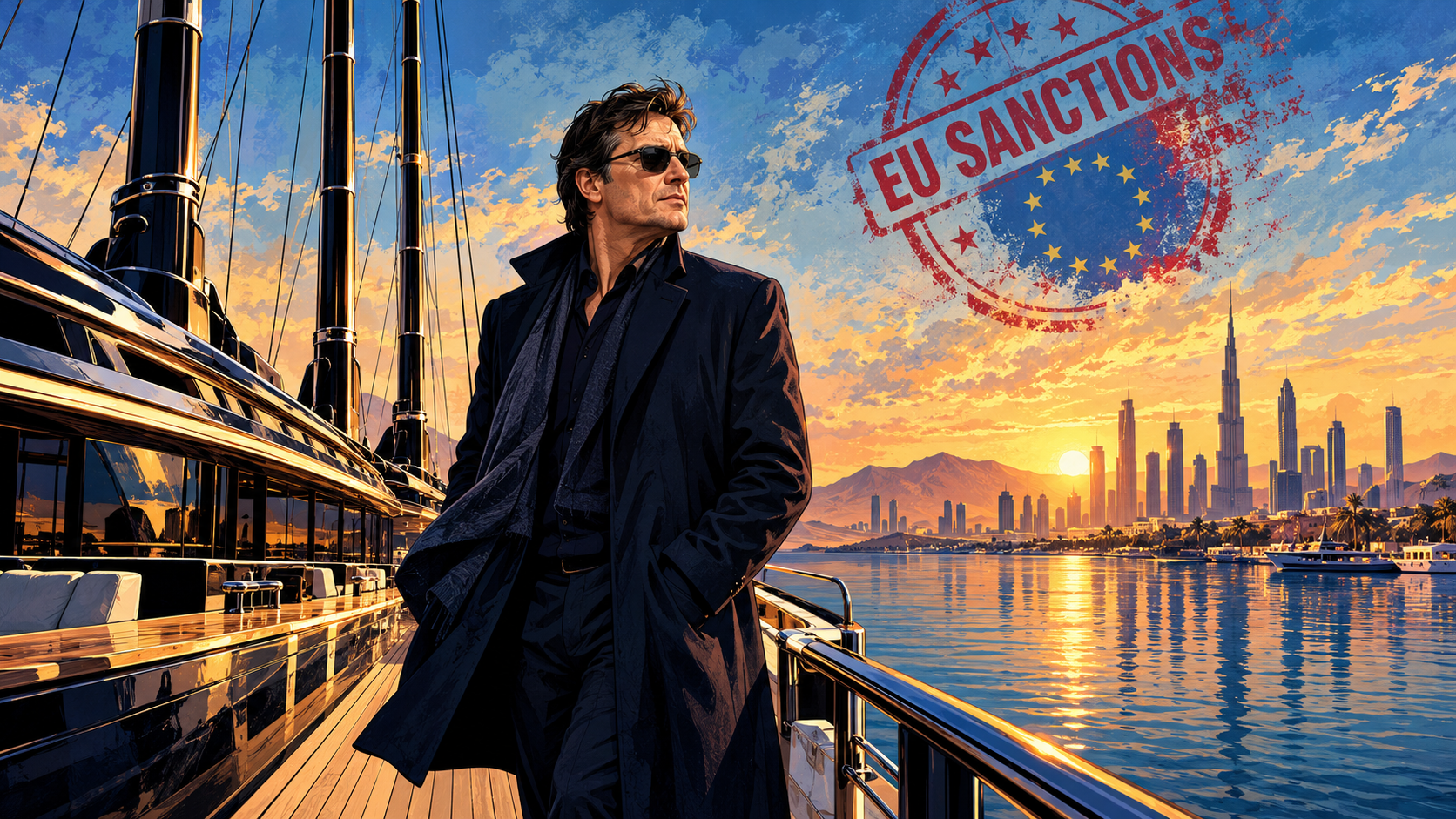
After February 24, 2022, the yacht’s flag state deregistered it. It sailed to Ras Al Khaimah, in the United Arab Emirates. It has remained there, stuck in port, unable to find a new flag state willing to register a vessel belonging to a sanctioned owner. An earlier motor yacht, also called A, was seized in Italy. Both became, in the global coverage of the sanctions era, visual shorthand for what it looked like when the West decided to punish Russian billionaires. Photographs of the sailing yacht A at anchor in Ras Al Khaimah — enormous, immaculate, going nowhere — became an image people recognised without always being able to say exactly who owned it.
II. The Birthday Present
How Sanctions Work, and What Happens When They Do Not Work as Intended
The theory behind sanctioning Russian oligarchs was articulated with particular clarity by President Biden in his 2022 State of the Union address. “We are coming for your ill-begotten gains,” he told the assembled Congress, the cameras, the Russians watching on their phones in Moscow. The theory assumed that men whose wealth was held in Western jurisdictions — whose yachts sailed in Mediterranean waters, whose children studied at Swiss schools, whose money moved through European banking systems — would experience the loss or threat of those assets as an intolerable cost. And that this cost would translate into pressure on Putin, or at minimum into the withdrawal of support for his project.
The theory was not entirely wrong. It was substantially incomplete. It assumed that the oligarchs’ relationship to their Western assets was one of dependency — that the Mediterranean villa, the Chelsea flat, the Gstaad chalet were necessities rather than preferences. For some, this was true. For others, including Melnichenko, whose primary industrial assets — coal fields in Siberia, fertiliser plants in Russia and Kazakhstan — were entirely outside Western reach, the sanctions created disruption without creating leverage.
EuroChem itself — the fertiliser company that generates the actual money — was never sanctioned. This was a deliberate choice by Western governments, who concluded that sanctioning a major global fertiliser producer would raise food prices across the developing world in ways that would be politically and morally untenable. Russia is the world’s largest exporter of fertilisers. EuroChem is among its largest producers. The logic of carving out the company while freezing its founder was that you could punish the man without punishing the food supply. The practical consequence was that Melnichenko remained, through the legal structure of a trust to which he had transferred his shares on the day before he was sanctioned, connected to a functioning industrial empire that continued to generate substantial revenue — while being personally unable to access a bank account in any Western country.
The Swiss bankers, unwilling to risk secondary exposure, closed EuroChem’s accounts in Zug anyway. The company’s trading operations relocated to Dubai. The Zug headquarters — once a busy office whose presence represented exactly the kind of legitimate Western integration that Switzerland’s financial centre had spent decades cultivating — became, in a few months, an empty building. A Swiss television crew that visited found the lights off and the desks cleared. The sign remained on the door.
“The sanctions were put like a blanket on the Russian economy. They affect everything. They affect people who have nothing to do with the war.”
— Andrey Melnichenko, COP27 climate talks, Sharm el-Sheikh, 2022
III. The Survival Strategy
Life in Dubai, and the Architecture of Endurance
Dubai has become, over four years of the sanctions era, a kind of informal headquarters for the displaced Russian billionaire class. It was not a planned migration. It was a gravitational consequence: the UAE did not join the Western sanctions regime, its banks — while cautious about secondary sanctions risk — remained more accessible than European institutions, its residency rules were straightforward for those with sufficient means, and its climate, for those accustomed to the Mediterranean as a lifestyle amenity, was familiar enough in character if not in temperature.
Melnichenko settled there. He acquired UAE citizenship — he holds both Russian and Emirati passports — which gave him a travel document that, unlike his Russian passport, did not mark him as a person of concern at border controls in the roughly two-thirds of the world that had not sanctioned him. He continued to contest the sanctions in courts. He filed challenges in the EU General Court, in Swiss administrative tribunals, and elsewhere. His wife Aleksandra, sanctioned by the EU in June 2022 on the theory that her ownership of the trust holding his shares constituted a circumvention vehicle, filed separately. The litigation was patient and expensive and proceeded, as such things do, at a pace that lawyers found professionally satisfying and their clients found agonising.
Meanwhile, the EuroChem problem did not resolve itself. The company continued to produce fertiliser. It continued to sell it — to India, to Brazil, to the markets of the Global South that had not joined the sanctions regime and had no particular reason to do so. But the banking infrastructure required to run a global commodity business — letters of credit, trade finance, the ordinary plumbing of international commerce — proved extremely difficult to access when every transaction potentially implicated a sanctioned beneficial owner. The company explored buying a bank in Mauritius. The exploration remained an exploration. The UAE banks that might otherwise have been useful were themselves wary of American secondary sanctions. A business that remained nominally functional was, in practice, operating in a state of chronic friction.
Russia’s collective billionaire wealth, meanwhile, had recovered and surpassed its pre-war peak. By mid-2026, the combined fortune of Russia’s sanctioned billionaire class stood at $697 billion — higher than the $663 billion recorded in 2021, before the invasion. This was not evidence that the sanctions had no effect. It was evidence that their effect was not the one intended. The Western companies that departed Russia left assets that were redistributed — often to oligarchs already well-positioned to receive them. The war economy created new demand for industrial production. The state poured money into sectors where the same billionaires happened to own the productive capacity. Melnichenko’s fertiliser business benefited, in a specific and uncomfortable way, from exactly the global food anxiety that the war had created — because food anxiety increases fertiliser prices, and EuroChem sells fertiliser.
IV. The Pivot
Sixty Hours with The Economist, and a Meeting in the Kremlin
In July 2026, The Economist published the results of what it described as sixty hours of conversations with Andrey Melnichenko — an interview of unusual length and, by any journalistic measure, unusual access. Melnichenko spoke about the war, about sanctions, about Putin, about Russia’s future, and — most strikingly — about his own position within it. The portrait that emerged was of a man who had, over four years in Dubai, arrived at a set of conclusions he was now prepared to state publicly, with the calculation that stating them publicly was itself a form of positioning.
He suggested that Putin should move away from one-man rule and delegate power — a statement that, from a man who had recently met privately with Putin in the Kremlin, was either courageous or calibrated or both. He warned that the West should avoid pushing Russia toward absolute collapse, on the grounds that a collapsing nuclear state was a danger of a different order than a losing one. He acknowledged, more directly than most Russians of his class had done publicly, that the business model of his generation — earning in Russia, banking in the West — had contained an assumption that turned out to be wrong. “Russian elite,” he said, in a formulation that his interviewers noted he returned to more than once, “made a mistake when they treated Russia as a place to earn money and the West as a place to protect wealth and the future of their families.”
In May 2025, he had his first personal meeting with Putin since the sanctions were imposed. He told the Russian president, according to The Economist’s account, that he wanted to participate more actively in Russian public life and “work for the good of the country.” Putin, according to those present, received this warmly. What followed, in the months between that meeting and the Economist interview, was a series of public statements that positioned Melnichenko as something new — not a dissident, not a loyalist, not a man who had simply waited out his difficulties in a comfortable Dubai apartment, but something harder to categorise: a billionaire who had reconsidered the terms of his existence and arrived at conclusions that were simultaneously self-serving and, by his own account, sincere.
“Russian elites made a mistake when they treated Russia as a place to earn money and the West as a place to protect wealth and the future of their families.”
— Andrey Melnichenko, The Economist, July 2026
The timing of the Economist interview — published in July 2026, two months before the EU agreed to lift his sanctions — has been noted by those who follow these things professionally. Whether the sequencing was coincidental is a question that admits no clean answer. Melnichenko’s legal team had been working the EU institutions for years. His lawyers’ argument — that his formal divestment of EuroChem and SUEK on the day before the sanctions were imposed was genuine rather than cosmetic — had been proceeding through the courts on its own track. The Economist interview represented a different kind of argument, made in a different venue: a public demonstration that here was a man who had thought carefully about his position, stated uncomfortable truths about his own class, and was prepared to engage with the Western audience on terms of mutual candour. Whether this argument contributed to the outcome in Brussels this week is not established. It is not implausible.
V. The Question That Remains
What the Sanctions Accomplished, and What They Did Not
Russia’s war in Ukraine is now in its fifth year. The billionaires who were supposed to exert pressure on Putin to end it have not done so — not collectively, not individually, not in any way that has affected the military reality on the ground. The oligarchic class, as Stanislav Markus of Harvard has observed, does not operate as a class. It operates as a collection of individuals, each managing their own relationship to the Kremlin on terms of individual survival, each calculating the risks of visible dissent against the costs of visible loyalty, and most arriving at the same conclusion: do neither. Be present. Be careful. Be patient.
This is, in the analysis of most serious students of Russian political economy, essentially what was going to happen. The sanctions were imposed with a theory of change that was coherent but depended on empirical assumptions — about how billionaires relate to their Western assets, about how the Kremlin relates to its business class, about whether there exists a threshold of personal cost above which oligarchic loyalty breaks — that turned out to be only partially correct. The assets mattered. The personal friction was real and in some cases severe. The political effect, on the war and on Putin’s conduct of it, was negligible.
What the sanctions accomplished, in the case of Melnichenko and others like him, was something different and more ambiguous than their architects intended. They pushed men who had been building Western lives — who had, in the assessment of their own stated self-interest, been integrating into a world that they preferred to Russia’s — back toward Russia. They removed the Western anchor. They eliminated the incentive structure that, whatever its moral foundations, had been the practical mechanism by which Russian capital was tied to Western rules. And they did this at exactly the moment when, if that mechanism had any relevance, its relevance was most needed.
Melnichenko is not a sympathetic figure in any simple sense. He was present at a meeting with Putin on February 24, 2022 — the day of the invasion — at which the discussion, according to those present, concerned the Western sanctions response. He built his fortune in the conditions of Russian capitalism in the 1990s, which is to say conditions that were not, by any conventional definition, conditions of fair competition. His self-presentation as a man who tried to do the right thing and was punished for it by association is one that many people, including many Ukrainians, find difficult to accept.
But the question of whether Andrey Melnichenko is sympathetic is not the same as the question of whether the policy that targeted him worked. On that question, the evidence, assembled across four years and sixty hours of candid conversation with a British magazine, is not encouraging. He is richer than he was when the sanctions were imposed. His company sells more fertiliser to more countries than it did in 2022. His EU sanctions have now been lifted. His yacht remains in Ras Al Khaimah, stuck in port not because he cannot afford to sail it but because it cannot find a flag state — a bureaucratic obstacle that his lawyers are, presumably, working on.
The man who would not fall is standing. The question that the people who tried to bring him down are left with is not what he will do next. It is what, if anything, they should have done differently — and whether they have the institutional honesty to ask it.
Sources: The Economist, July 2026 (60-hour interview with Andrey Melnichenko); Reuters, September 21, 2026 (EU sanctions removal agreement); Carnegie Endowment for International Peace, “Russia’s Oligarchs Must Walk a Wartime Tightrope,” February 2026; Business Insider, Weltwoche interview, 2022; Re:Russia analytics, billionaire wealth data 2021–2026; Forbes Russia billionaires list 2026; US Treasury OFAC designation records; OpenSanctions database; Swiss Radio and Television (SRF) Rundschau, EuroChem Zug investigation; Harvard Davis Center, Professor Stanislav Markus, analysis of oligarchic political behaviour; Financial Times, Melnichenko interview, 2023; Global News, COP27 remarks, 2022.
INTELLIGENCEORIGINAL.COM · INTELLIGENCE & GEOPOLITICS · SEPTEMBER 22, 2026
Leave a Reply