

Global Intelligence | Analysis | 26 November 2026 | Bernd Pulch (M.A.)
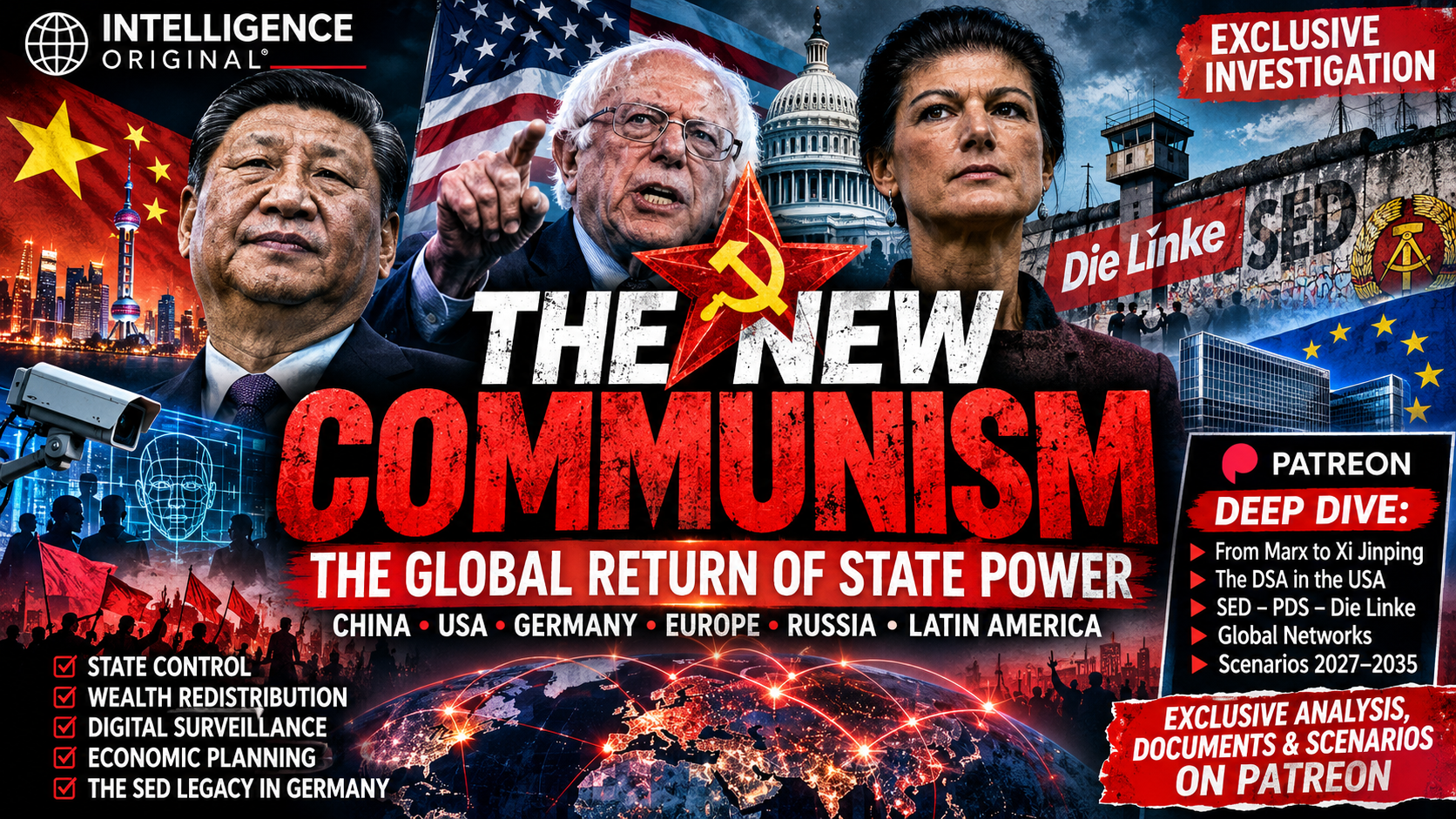
New Communism: the global return of state power?
From Beijing to Washington and Berlin, the relationship between private ownership, public authority and political freedom is contested. But the phrase New Communism is a hypothesis, not a diagnosis of every intervention by government. The real question is whether economic concentration and expanding administrative powers are accompanied by effective democratic accountability.
China: the party above the market
China offers the clearest example of a ruling communist party combining market mechanisms with political monopoly. Article 1 of its constitution establishes Communist Party leadership as fundamental to the system; Article 15 establishes a socialist market economy. Private enterprise and foreign investment coexist with public ownership and strategic direction. This is not the abolition of markets. It is a model in which markets operate within a political order that does not permit competitive national alternation of ruling parties. Constitution of China
United States: socialist movements and industrial policy
The Democratic Socialists of America advocate replacing capitalism with democratic socialism. Their 2026 program describes a new constitutional order as an ambition. DSA is an independent political organization, not the United States government. American industrial subsidies, procurement, tariffs and strategic technology restrictions can also originate from conservative nationalism or national security policy. None of these instruments alone establishes communist rule. The relevant comparison is how intervention affects competition, accountability and the ability of citizens to challenge decisions. DSA program
Germany: from SED to Die Linke
The SED was created in 1946 through the merger of KPD and SPD in the Soviet occupation zone under substantial coercion. It dominated the GDR until the peaceful revolution of 1989. Its successor organization became the PDS, which merged with WASG in 2007 to form Die Linke. This organizational lineage deserves scrutiny, but the contemporary party operates in a competitive constitutional democracy. Its program calls for changes to ownership structures and economic democracy. Those proposals must be examined individually rather than treated as evidence of a restored dictatorship. Party program · Historical background
The worldwide picture
Vietnam combines communist party leadership with market-oriented economic development. Cuba retains a communist political system while allowing limited private economic activity. North Korea represents a much more closed authoritarian model. Venezuela’s socialist political project must be assessed separately from each of these systems. Russia illustrates how concentrated state and private economic power can coexist without a contemporary communist ruling ideology. European industrial policy, welfare institutions and regulation likewise cannot be classified by public spending alone.
The next frontier: digital power
Artificial intelligence, biometric databases, automated eligibility decisions and financial monitoring can expand administrative power in any political system. They can also improve public services and detect fraud. The decisive safeguards are independent courts, transparency, proportionality, meaningful appeal rights and enforceable privacy protections. The risk is not a particular technology but its use without effective constraints.
The Patreon deep dive
Our expanded analysis examines the ideological history, property regimes, party structures, surveillance, financial instruments and three conditional scenarios through 2035. The central question is whether citizens retain the practical ability to replace governments, challenge administrative decisions and control their property within predictable law. Explore the Intelligence Original premium dossier. The expanded dossier is in preparation.
DEUTSCHE VERSION – Der neue Kommunismus
Von Peking über Washington bis Berlin wird das Verhältnis zwischen Privateigentum, staatlicher Macht und individueller Freiheit neu verhandelt. Der Begriff neuer Kommunismus ist dabei eine zu prüfende These, keine pauschale Diagnose staatlicher Eingriffe. Entscheidend ist, ob wirtschaftliche und administrative Macht wirksam demokratisch kontrolliert werden.
China: die Partei über dem Markt
China verbindet die Führung einer kommunistischen Partei mit Marktmechanismen. Artikel 1 der Verfassung verankert die Parteiführung, Artikel 15 die sozialistische Marktwirtschaft. Private Unternehmen und ausländische Investitionen bestehen neben öffentlichem Eigentum und strategischer Wirtschaftslenkung. Anders als in parlamentarischen Demokratien gibt es keinen freien nationalen Wettbewerb um die Ablösung der Regierungspartei. Verfassung
USA: demokratische Sozialisten und Industriepolitik
Die Democratic Socialists of America streben die Überwindung des Kapitalismus an. Ihr Programmdokument von 2026 nennt eine neue Verfassungsordnung als Ziel. Die DSA ist jedoch nicht die US-Regierung. Subventionen, Zölle und strategische Technologiebeschränkungen können auch nationalkonservativ oder sicherheitspolitisch motiviert sein. Solche Maßnahmen sind für sich genommen kein Beleg kommunistischer Herrschaft. DSA-Programm
Deutschland: SED, PDS und Die Linke
Die SED entstand 1946 aus der unter erheblichem Zwang vollzogenen Vereinigung von KPD und SPD in der sowjetischen Besatzungszone. Sie beherrschte die DDR bis zur friedlichen Revolution 1989. Aus ihrer Nachfolgeorganisation ging die PDS hervor, die sich 2007 mit der WASG zur Partei Die Linke zusammenschloss. Die organisatorische Kontinuität ist historisch relevant. Die heutige Partei agiert jedoch im demokratischen Mehrparteiensystem und muss anhand ihrer tatsächlichen Forderungen und Handlungen beurteilt werden. Ihr Programm strebt Veränderungen der Eigentumsverhältnisse und Wirtschaftsdemokratie an. Parteiprogramm
Die globale Perspektive
Vietnam verbindet kommunistische Parteiführung mit marktwirtschaftlicher Entwicklung. Kuba lässt begrenzte private Wirtschaftstätigkeit zu; Nordkorea besitzt ein wesentlich stärker abgeschottetes autoritäres System. Venezuela ist gesondert zu untersuchen. Russland zeigt, dass staatliche und private Machtkonzentration auch ohne kommunistische Regierungspartei möglich ist. Europäische Sozialstaaten und Industriepolitik sind nicht allein anhand der Staatsausgaben einzuordnen.
Digitale Macht und Zukunft
KI, biometrische Datenbanken und automatisierte Entscheidungen können Verwaltungsmacht ausweiten, aber auch Dienstleistungen verbessern. Unabhängige Gerichte, Transparenz, Datenschutz und wirksame Rechtsmittel sind entscheidend. Die Patreon-Vertiefung analysiert die ideologischen Wurzeln, Eigentumsordnungen, Finanzinstrumente und bedingten Zukunftsszenarien bis 2035. Patreon. Die Langfassung befindet sich in Vorbereitung.
Editorial note / Redaktioneller Hinweis: Comparative political analysis, not an assertion of a coordinated international conspiracy. / Vergleichende politische Analyse, keine Behauptung einer koordinierten internationalen Verschwörung.
Journalism Track Record · Aristotle AI Whitepaper · Global Reach · Donations · Join · YouTube · X · Telegram
Leave a Reply