

Intelligenceoriginal.com · Investigation · September 23, 2026
The Algorithm That Decides Who Is a Terrorist
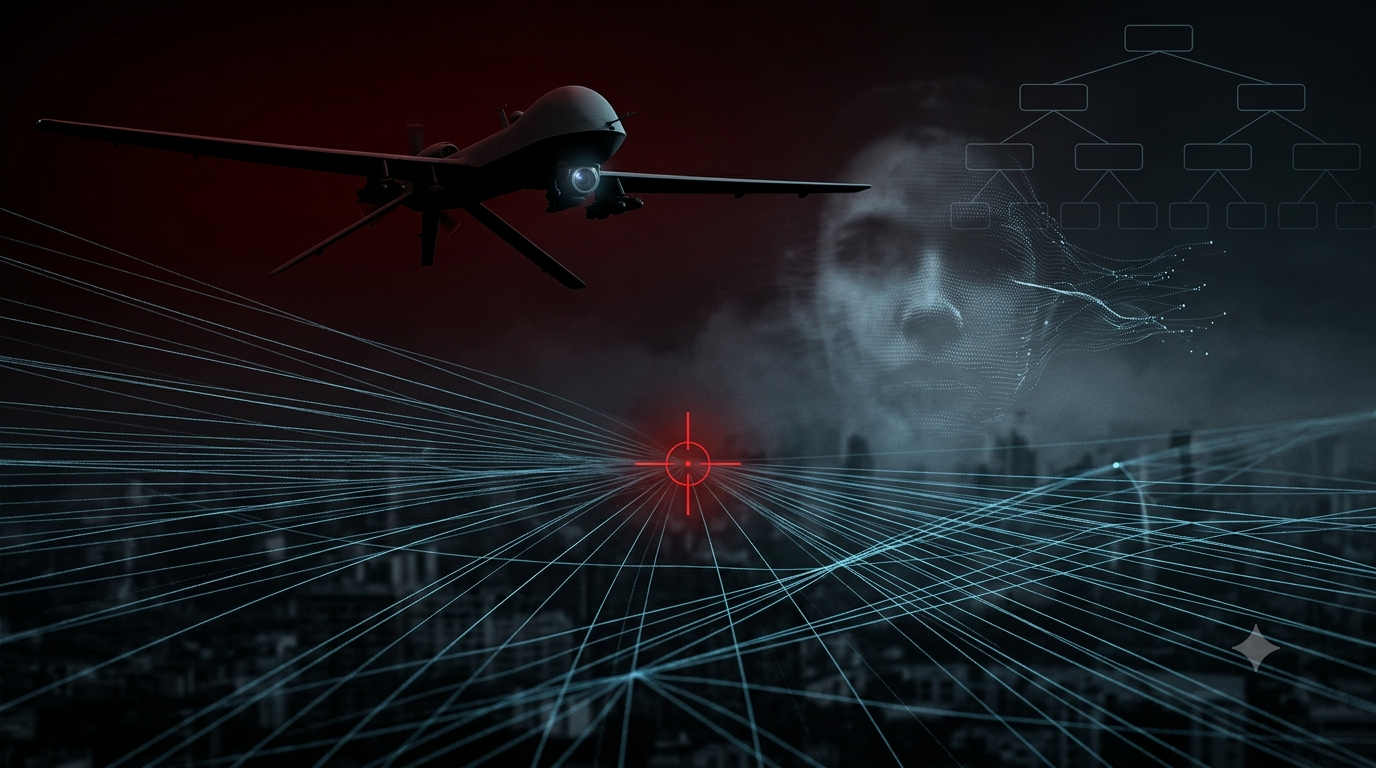
In Gaza, an AI system called Lavender generated 37,000 target recommendations in the opening weeks of the war. In Iran, Palantir’s Maven helped the Pentagon strike 13,000 targets in 38 days. In Ukraine, a Russian drone powered by an Nvidia chip killed three civilians without a human operator. The machines are no longer assisting. They are deciding.
By the Intelligence Original Editorial Desk · September 23, 2026 · 18 min read
The kill chain used to be a metaphor. Now it is a workflow.
At a Pentagon briefing earlier this year, an official described the system as operating “almost like magic.” The system was Project Maven — an AI platform built by Palantir that fuses satellite imagery, signals intelligence, and sensor data to generate targeting recommendations in real time. During the 38-day US-Israeli campaign against Iran, Maven helped the Pentagon strike more than 13,000 targets, according to testimony delivered to the Tom Lantos Human Rights Commission on September 16, 2026.
In Gaza, an Israeli system known as Lavender reportedly produced 37,000 target recommendations in the opening weeks of the war, leading to 15,000 strikes. The system, according to documents and whistleblower testimonies, was trained on surveillance data — phone calls, movements, interactions — collected across Gaza’s entire telecommunications network.
And in Ukraine, on July 6, 2026, a Russian drone equipped with an Nvidia Jetson Orin minicomputer — the same chip used in civilian robotics — killed three civilians in Zaporizhzhia. The drone had no radio link. It selected its target autonomously.
Three theaters. Three systems. One common architecture.
The algorithmic targeting system has become the defining military technology of this decade. And the legal frameworks designed to govern it do not exist.
I. The Systems
Maven, Lavender, Gospel: The Architecture of Algorithmic War
Project Maven was launched by the US Department of Defense in 2017 as a modest initiative to help analysts process drone footage. Eight years later, it has evolved into the operational backbone of American targeting. Maven integrates air control, command functions, satellite imagery, and intelligence on both friendly and adversarial forces. According to expert Alok Mehta, the system “fuses these inputs to generate a comprehensive operational picture in real time”. Recent advances in generative AI have enabled commanders to interact with Maven through natural language — broadening access beyond technical specialists.
Lavender operates differently. Developed by the Israel Defense Forces, it is an “AI-enabled” data processing system designed to mark suspected operatives in the military wings of Hamas and Palestinian Islamic Jihad. It detects people, vehicles, and objects in real time. The Israeli military has called it a “game changer” in yielding targets. Whistleblower testimonies collected for the documentary NAZA — which received the special jury prize at the Venice International Film Festival — describe a system that uses mass surveillance data to identify targets based on phone calls, movements, and interactions. One interviewee described the work as “like a video game because everything is done remotely.” Another called it “insanely fun”.
The Gospel — also known as Habsora — is the third pillar. Developed by Israel’s Unit 8200, it processes satellite imagery, drone telemetry, SIGINT, and historical databases to identify structures as targets. The system can generate over 200 targets in 10-12 days — a 50-fold increase over traditional human analysis. Internal IDF sources call it the “Target Factory”.
Together, these systems form a kill chain that operates at machine speed. The Gospel identifies the where. Lavender identifies the who. And a third system — “Where’s Daddy?” — tracks targets to their homes for strikes.
II. The Palantir Problem
The Company That Owns the Battlefield
If there is a single corporate entity at the center of the algorithmic warfare revolution, it is Palantir Technologies.
Founded with partial funding from the CIA, Palantir stepped in to replace Google as the primary supplier for Project Maven after Google withdrew in 2018 following employee protests. It has since become the operational backbone of Maven. In 2025, the company signed a $10 billion agreement with the US military. In August 2026, it won a $192 million production contract for the TITAN ground station program — with Palantir’s share valued at $127 million.
But Palantir’s role extends beyond the Pentagon. Reports and expert assessments indicate that Palantir systems have been deployed by the Israeli military in Gaza, Lebanon, and operations linked to Iran. The company’s platforms — Gotham, AIP, Foundry, and Skykit — combine large-scale data analysis with operational AI systems. Palantir co-founders Alex Karp and Peter Thiel held a board meeting in Tel Aviv in January 2024 and met Israeli President Isaac Herzog. Karp said demand from Israel had increased after October 7, 2023.
Former Microsoft employee Ibtihal Aboussad, speaking at a protest in April 2025, described Palantir’s role bluntly: “Palantir is essentially weaponizing artificial intelligence and also weaponizing data analysis to make deadly decisions”. She warned that military officials could evade accountability by attributing attack decisions to technology — that Palantir’s systems function as “a shield protecting Israel from legal” consequences.
III. The Autonomous Drone
Zaporizhzhia: The First Documented Autonomous Kill
On July 6, 2026, a small Russian drone swooped toward a Ukrainian gas station in Zaporizhzhia. It exploded into a wall. Three civilians were killed, including a university student.
The drone was powered by an Nvidia Jetson Orin — an inexpensive minicomputer designed for civilian robotics and machine vision. Ukrainian forensic examiners recovered the chip from the wreckage. The drone had no radio link. It left the strike decision entirely to the onboard computer.
This was not a semi-autonomous system. Earlier AI-guided drones had a “human in the loop” safety button. They used AI only in the last several hundred yards of flight to make them impervious to jamming. The Zaporizhzhia drones, by contrast, left the strike decision entirely to the machine.
Both Russia and Ukraine have deployed drones with autonomous functions using AI to recognize targets, navigate, and self-guide. In November 2025, a Ukrainian first-person-view drone used an AI-assisted guidance system to strike a probable Russian tank after its communications link with its operator was disrupted. At the advanced end, Russia reportedly fielded at least one model of a fully autonomous UAV in early 2025 — the V2U loitering munition, equipped with an Nvidia computer and no external communications systems.
“We are now dangerously close to crossing a moral red line: the autonomous targeting of humans by machines.”
— António Guterres, UN Secretary-General, August 2026
IV. The Norms Vacuum
International Law Has Not Caught Up
The legal frameworks governing autonomous weapons were designed for a world that no longer exists.
The International Committee of the Red Cross has stated that autonomous weapon systems raise “serious humanitarian, legal and ethical concerns.” It has called for international rules prohibiting unpredictable AWS and the use of AWS to target human beings.
In August 2026, UN Secretary-General António Guterres and ICRC President Mirjana Spoljaric Egger issued a joint appeal. They called for controls on two types of autonomous weapons: those whose actions are “unpredictable” and those that target human beings. They urged states to begin negotiations on a legally binding agreement.
The head of disarmament affairs at UN Geneva, Mélanie Régimbal, stated that systems that select or engage targets and take human lives without human control and judgement “are politically unacceptable, morally repugnant and should be prohibited under international law”.
But the negotiations have not yet produced a treaty. The seventh Review Conference of the Convention on Certain Conventional Weapons is scheduled for November 2026 in Geneva. The UN and ICRC describe it as the “clearest path available” for States to agree to move towards negotiations on a legally binding instrument.
Meanwhile, the systems are being deployed. The proliferation is accelerating. Only a small number of countries currently possess high-end AI targeting systems equivalent to Maven: China, Israel, North Korea, Russia, South Korea, Ukraine, the United Kingdom, and the United States. But India, Iran, Pakistan, Saudi Arabia, Türkiye, and the UAE have the capacity and incentives to acquire this technology soon.
The norms vacuum is not a hypothetical risk. It is the operating environment.
V. The Human in the Loop
The “Human in the Loop” Is a Legal Fiction
The official position of the Israeli military is that decisions regarding the selection and approval of strikes were made “by human personnel only… and not by artificial intelligence”. The Pentagon has made similar statements about Maven.
But a visual investigation by Airwars and the AI Now Institute, titled “Anatomy of a Kill Chain,” suggests the human role is narrower than official statements imply. The project walks through a fictional but realistic AI-enabled strike across six stages: sensor and data collection, surveillance, intelligence and identification, selection, deadly strike, and post-strike assessment. In some US operations, the investigation found that only two of six kill chain stages still involve a human.
The investigation follows a single target: a phone signal, a translation error, a risk score, and a strike. It shows how errors compound across a kill chain until a school teacher running a food distribution point is misidentified as a combatant.
The technology depicted is not speculative. It draws on documented systems already in use in Ukraine, Gaza, and Iran. The “beforemath harms” — the wrongful and harmful production, interpretation, and categorisation of data that “mark” civilians as potential militants — are pre-programmed into the system.
A commander exercising command responsibility for AI-derived target recommendations cannot fully audit those recommendations on a clock that closes in ninety seconds. As one analysis noted, the commander must exercise responsibility for recommendations they “neither built nor reviewed, and cannot fully audit”.
VI. What Comes Next
The Algorithm Is Not the Problem. The Accountability Is.
The algorithmic targeting system is not inherently illegal. International humanitarian law permits targeting military objectives, provided that the principles of distinction, proportionality, and precaution are respected. AI can, in theory, improve compliance with these principles by processing information faster and more comprehensively than human analysts.
But the systems currently deployed are trained on data. And data is not neutral. Lavender was trained on surveillance data from Gaza’s telecommunications network. The Gospel was trained on satellite imagery and SIGINT. Maven was trained on sensor feeds and intelligence databases. What the algorithms learn depends on what they are fed.
The deeper problem is not the technology. It is the accountability gap. When an AI system generates 37,000 target recommendations, and 15,000 strikes follow, who is responsible for the errors? The commander who approved the strike? The intelligence officer who trained the model? The company that built the software? The state that deployed it?
The answer, at present, is no one — and everyone. The legal frameworks that would assign responsibility do not exist. The international negotiations that might create them have not concluded. And the systems are being deployed at scale while the lawyers debate.
“Conflict is not a story of precision, distinction and restraints. It is a story of civilians killed, families displaced, hospitals, schools and homes destroyed at ever greater speed and scale.”
— Laurent Gisel, ICRC, August 2026
The machine does not get tired. It does not blink. It does not hesitate. And it does not ask whether the person on the other end of the phone signal is a combatant or a school teacher.
The algorithm decides. The human approves. The error compounds. And the accountability evaporates.
Sources: Carnegie Endowment for International Peace, testimony to the Tom Lantos Human Rights Commission, September 16, 2026; Airwars and AI Now Institute, “Anatomy of a Kill Chain,” August 2026; Journal of International Humanitarian Legal Studies, “The Use of ‘Lavender’ in Gaza and the Law of Targeting,” 2025; netzpolitik.org, “Civilian harm is pre-programmed into the system,” September 2026; The New York Times, “Minicomputers Made by Nvidia Are Powering Moscow’s A.I. Drones,” August 2026; The Conversation, “Russia-Ukraine war is accelerating the dangerous race toward fully autonomous drones,” September 2026; UN Office for Disarmament Affairs, August 2026; News18, “200 Targets In 10 Days: What Is Gospel, Israel’s AI For Wars?” March 2026; Times of Israel, “IDF rejects testimonies in documentary about AI-powered civilian killings in Gaza,” September 2026; Palantir investor filings and contract announcements, 2026.
Related Intelligence
- The Man Who Would Not Fall — Andrey Melnichenko and the Architecture of Survival (Profile, September 22, 2026)
- The Billionaire Escape Map — The New Geography of Global Wealth (Dossier No. 001)
- The New Offshore World — The Complete Intelligence Assessment of the Modern Offshore Architecture (Dossier No. 002)
BERND PULCH — NO MORE FAIRY TALES
For over 30 years, Bernd Pulch has been digging where others refuse to look. He publishes uncensored primary-source intelligence, original scanned documents, forensic analysis, and raw data that mainstream outlets either ignore or actively suppress. Stasi archives, offshore financial trails, lawfare operations, geopolitical ruptures, and the hidden networks that actually move power — this is the vault.
JOIN THE INTELLIGENCE DESK: PATREON.COM/BERNDPULCH
INTELLIGENCEORIGINAL.COM · INTELLIGENCE & GEOPOLITICS · SEPTEMBER 23, 2026
© 2026 INTELLIGENCEORIGINAL.COM — ALL RIGHTS RESERVED
Leave a Reply