

INTELLIGENCEORIGINAL.COM – EXCLUSIVE INTELLIGENCE ON THE NEW FINANCIAL WORLD ORDER
—
📺 YouTube: youtube.com/@bernd_pulch | 🐦 X (Twitter): x.com/berndsocial1 | 📢 Telegram: t.me/ABOVETOPSECRETXXL | 🔓 Reveal the Whole Truth: berndpulch.org/join
—
📡 ABOVETOPSECRETXXL – BREAKING INTELLIGENCE REPORT
Goldman Sachs AI 15 million jobs displacement
DATE: OCTOBER 31, 2026
TIME: 06:00 UTC
CLASSIFICATION: ABOVE TOP SECRET – SUBSCRIBERS ONLY
SOURCE: INTELLIGENCEORIGINAL.COM – THE ONLY OUTLET WITH A LICENSE TO SPY
—
🔥 BREAKING: GOLDMAN SACHS WARNS AI COULD DISPLACE 15 MILLION US WORKERS — BUT THE LAYOFFS ARE WAITING FOR A RECESSION — 9 PERCENT OF THE WORKFORCE, ONE IN ELEVEN — OLDER WORKERS HIT HARDEST — 120,136 AI-LINKED JOB CUTS ALREADY ANNOUNCED THIS YEAR
—
This report is based on reporting from Fortune, Business Insider, NDTV Profit, Times of India and DigitalToday, citing Goldman Sachs Research. The figures are Goldman’s estimates, not official statistics. The presumption of innocence applies.
—
Good morning. This is a Breaking Intelligence Report from ABOVETOPSECRETXXL. Goldman Sachs has put a number on the AI jobs question, and the number is 15 million.
In a research note published on 22 October 2026, Goldman economist Joseph Briggs estimated that up to 9 percent of the US workforce could be “displaced during the AI transition” — roughly one in eleven workers, or approximately 15 million people. But the bank’s central finding is about timing, not scale: the layoffs are not coming in a sudden wave. They are waiting for a recession.
—
THE NUMBER: 9 PERCENT, 15 MILLION
Status: CONFIRMED — GOLDMAN SACHS RESEARCH
The estimate rests on Goldman’s forecast that AI will eventually raise productivity by 15 percent in the US and other developed economies. On that assumption, up to 9 percent of workers could be displaced from their current roles during the transition, with slower hiring weighing on employment by a further 3 percent.
Key Developments:
· “9% of workers being displaced by AI would correspond to 15 million workers,” Briggs said, comparing the scale to the tech-driven upheaval of the late 1990s and early 2000s.
· The figure does not mean 15 million jobs will disappear. It refers to the scale of workers pushed out of existing roles who would need to move into other fields — labour-market redeployment, not permanent job destruction.
· Briggs rejected the idea that jobs will be permanently displaced, arguing it fixates on jobs destroyed while ignoring those created. “If we look back over the last 80 years, around 85% of job growth has been driven by the technological creation of new positions.”
· The US labour market creates roughly 30 million jobs and destroys 29 million every year. Against that backdrop, even a 5 percent pickup in the pace of job creation would be enough to reabsorb everyone AI displaces.
—
THE TIMING: WAITING FOR A RECESSION
Status: CONFIRMED — GOLDMAN SACHS RESEARCH
This is the report’s central argument, and it is the one that matters for anyone planning beyond the next quarter.
Key Developments:
· Briggs examined decades of data on how technology has replaced workers and found that “automation-related labor disruption is limited when the overall economy is healthy but accelerates during cyclical slowdowns.”
· “AI-related labor disruptions could well amplify the broader business cycle,” he wrote. Companies tend to automate work and shed labour costs when the economy starts to slow.
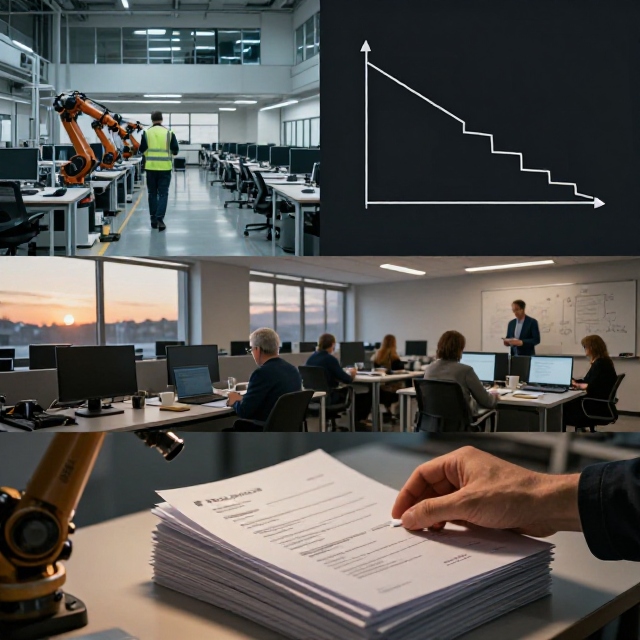
· The historical pattern is documented: the share of Americans in routine jobs — clerks, secretaries, factory machine operators, mechanics — “has remained stable during expansions but declined sharply during downturns.” The line drops in steps for the recessions of the early 1980s, 2001, 2008, and 2020 — and does not climb back.
· Across 25 occupations disrupted by past technological shifts, employment fell an additional 4 percent over five years for every percentage-point increase in the national unemployment rate.
· “The timing and extent of automation and labor disruption will likely track the overall economic cycle,” Briggs wrote.
The implication: The current labour market is relatively resilient. The displacement is not. If a recession arrives, the AI transition accelerates — and the layoffs arrive with it.
—
THE EARLY SIGNS: ALREADY VISIBLE
Status: CONFIRMED — GOLDMAN SACHS, CHALLENGER, STANFORD
The sectors:
· In sectors where AI tools are being used — tech, management consulting, and graphic design — Briggs estimates the technology is cutting 10,000 to 15,000 jobs from monthly employment growth.
· That means AI is affecting the market by reducing demand for new hiring rather than directly replacing people.
The displaced workers:
· Goldman economist Pierfrancesco Mei found that people displaced from AI-exposed jobs since 2025 took about a month longer to find new employment than other workers who lost their jobs.
· They were around 10 percentage points more likely to remain unemployed a year after being laid off.
· Older workers were hit hardest: those aged 35 and above who lost jobs in AI-exposed occupations took approximately five weeks longer than other displaced workers to return to full-time employment. For workers below 35, the difference was around three weeks.
The layoff data:
· Employers cited AI in 120,136 announced job cuts through September, accounting for around 21 percent of all announced layoffs, according to Challenger, Gray & Christmas.
· Job losses in the tech sector outpace any other industry, accounting for 29 percent of all job cuts last month.
The Stanford finding:
· Research from Stanford’s Digital Economy Lab found that employment among workers aged 22–25 in the most AI-exposed occupations was around 19 percent below the level expected based on less-exposed jobs — a potential hiring slowdown for young workers entering the market.
—
THE COUNTERARGUMENT: A RISING TIDE, NOT A CRASHING WAVE
Status: CONFIRMED — MIT RESEARCHER, BUSINESS INSIDER
Not everyone expects a big disruption. Neil Thompson of MIT, who appeared on the same Goldman podcast, argued the shift will be slower than AI’s rapidly improving capabilities suggest.
Key Points:
· Capability is only step one. An AI system also needs access to the right information — tricky in fields like medicine, where privacy rules get in the way — and it has to be cheap enough to be worth running. Those hurdles mean adoption may lag well behind what AI can technically do.
· Most jobs can be partly automated rather than eliminated, and the outcome depends on which tasks machines take over.
· The GPS precedent: When GPS automated taxi drivers’ expert knowledge of city routes, wages fell, but the number of drivers exploded.
· Thompson’s framing: AI is a “rising tide” workers can see coming and adapt to, not a “crashing wave” that sweeps them away.
—
THE BROADER CONTEXT: 300 MILLION GLOBALLY
Status: CONFIRMED — GOLDMAN SACHS RESEARCH, MARCH 2026
The US figure is part of a larger estimate. Goldman Sachs Research has estimated that around 300 million jobs globally are exposed to automation by AI — with the majority of the transition expected within the next 10 years.
Key Points:
· In the US alone, AI could potentially automate tasks that account for 25 percent of all work hours.
· Goldman’s economists estimate a modest 0.6 percentage point increase in unemployment during this time — noting that a faster wave of adoption could lead to “much larger” economic disruptions.
· The distinction is critical: exposure is not displacement. A job exposed to automation is not the same as a job lost.
—
WHAT TO WATCH TODAY
· Whether the US enters a recession in the next 12–18 months, which Goldman identifies as the trigger for accelerated AI displacement
· Whether the 120,136 AI-linked job cuts through September are revised upward
· Whether the Federal Reserve’s rate path affects hiring and investment in automation
· Whether Congress takes up any AI workforce legislation before the midterms
· Whether the Stanford finding on 22–25-year-old hiring is confirmed by subsequent data
—
INTELLIGENCE ASSESSMENT – THE BIG PICTURE
First: The 15 million figure is a displacement estimate, not a layoff forecast. It measures workers who will need to move roles, not workers who will lose work permanently. Briggs himself says 85 percent of job growth over 80 years came from technology creating new roles. The number is alarming; the mechanism is redeployment.
Second: The timing is the finding. Goldman’s central argument is that AI displacement is cyclical — it accelerates in recessions. The current labour market is resilient. A downturn would change that. The question is not whether AI will displace workers — it will — but whether the displacement arrives gradually or in a recessionary shock.
Third: The early signs are already visible in specific sectors. Tech, consulting and graphic design are shedding 10,000–15,000 jobs from monthly growth. Older workers take five weeks longer to recover. Stanford finds 22–25-year-olds in AI-exposed roles at 19 percent below expected employment. These are not projections; they are current data.
Fourth: The counterargument is credible but incomplete. Thompson’s “rising tide” framing is supported by the GPS precedent and by the adoption lag. But it does not address the cyclical acceleration that Goldman documents. A rising tide can still drown people who cannot swim — or who are caught in a recession.
Fifth: The policy response is absent. Goldman’s estimate implies a redeployment challenge of 15 million workers over a decade. No legislation, no retraining programme, and no wage insurance scheme of that scale is under discussion in the sources reviewed. The question is not whether the market can absorb the shift — Goldman says it can — but whether the workers can.
—
CLOSING REMARK
This is your ABOVETOPSECRETXXL Breaking Intelligence Report. Goldman Sachs has estimated that AI could displace 9 percent of the US workforce — roughly 15 million workers — during the AI transition. The layoffs are not arriving in a sudden wave; they are waiting for a recession, when companies historically accelerate automation and shed labour costs. Early signs are already visible: 120,136 AI-linked job cuts announced through September, older workers taking five weeks longer to recover, and 22–25-year-olds in AI-exposed roles at 19 percent below expected employment. MIT’s Neil Thompson argues the shift will be a rising tide, not a crashing wave. Goldman’s data suggests the tide rises fastest in a downturn.
The question is not whether AI will change the labour market — it will — but whether the change arrives gradually enough for workers to adapt.
We will continue to follow this story. Follow us on Telegram for real-time updates.
Stay informed. Stay vigilant. Stay uncompromised.
—
EDITOR’S NOTE — ON FRAMING, SOURCES AND PROVENANCE
This report is built from Fortune (22 October 2026), Business Insider (3 July 2026 and 23 October 2026), NDTV Profit (30 October 2026), Times of India (23 October 2026) and DigitalToday (6 July 2026), all citing Goldman Sachs Research.
On the 9 percent / 15 million figure: The estimate is from Goldman economist Joseph Briggs, based on a baseline scenario of AI raising productivity by 15 percent. It is a displacement estimate, not a layoff forecast.
On the recession timing: The finding that automation accelerates during downturns is from Briggs’s analysis of employment data back to 1979.
On the early signs: The 120,136 AI-linked job cuts are from Challenger, Gray & Christmas. The older-worker recovery data is from Goldman economist Pierfrancesco Mei. The Stanford finding is from the Digital Economy Lab.
On the 300 million global figure: The estimate is from Goldman Sachs Research, published in March 2026, and refers to jobs exposed to automation, not jobs lost.
A note I owe you: The specific figures — 9 percent, 15 million, 120,136 job cuts, 10,000–15,000 monthly, five weeks, 19 percent — come from the sources cited. I have not independently retrieved them. Before publication, the Goldman Sachs research note, the Challenger data and the Stanford study should be checked against their originals.
—
📁 EXCLUSIVE MATERIAL – PATREON
Full dossiers on the Goldman Sachs AI jobs estimate — the research note, the historical automation data, the sectoral breakdown and the Stanford findings — are available only at patreon.com/berndpulch.
Available exclusively to subscribers:
· Goldman AI Jobs Tracker – The 9 percent estimate, the 15 million figure, and the productivity assumption
· Recession Trigger Dossier – Historical automation data, cyclical patterns, and the 25-occupation analysis
· Sectoral Breakdown – Tech, consulting, graphic design, and the 10,000–15,000 monthly figure
· Older Worker Impact Log – The five-week recovery gap and the age-divide data
· Stanford Digital Economy Lab Archive – The 19 percent hiring slowdown for 22–25-year-olds
· Predictive Intelligence – Assessments of recession timing, policy response, and labour market absorption
Support independent intelligence work. Access the raw material. Only at patreon.com/berndpulch.
—
© INTELLIGENCEORIGINAL.COM – ABOVE TOP SECRET ORIGINAL DOCUMENTS – THE ONLY OUTLET WITH A LICENSE TO SPY
—
📢 SHARE THIS INFORMATION
📺 YouTube: youtube.com/@bernd_pulch
🐦 X (Twitter): x.com/berndsocial1
📢 Telegram: t.me/ABOVETOPSECRETXXL
🔓 Reveal the Whole Truth: berndpulch.org/join
—
🔓 Support independent intelligence work — Monero (XMR):
“`
45cVWS8EGkyJvTJ4orZBPnF4cLthRs5xk45jND8pDJcq2mXp9JvAte2Cvdi72aPHtLQt3CEMKgiWDHVFUP9WzCqMBZZ57y4
“`
https://api.qrserver.com/v1/create-qr-code/?data=45cVWS8EGkyJvTJ4orZBPnF4cLthRs5xk45jND8pDJcq2mXp9JvAte2Cvdi72aPHtLQt3CEMKgiWDHVFUP9WzCqMBZZ57y4&size=150×150
—
⚠️ DISCLAIMER
This article is an investigative report based on publicly available sources. The 9 percent and 15 million figures are Goldman Sachs estimates, not official statistics. The 300 million global figure refers to jobs exposed to automation, not jobs lost. The Challenger and Stanford data are from the sources cited. The presumption of innocence applies to all named individuals. Readers are encouraged to independently verify the underlying facts. This is not legal advice.
—
© INTELLIGENCEORIGINAL.COM – ABOVE TOP SECRET ORIGINAL DOCUMENTS – THE ONLY OUTLET WITH A LICENSE TO SPY
—
Share this information – the truth must come to light.
INTELLIGENCEORIGINAL.COM – EXKLUSIVE INFORMATIONEN ZUR NEUEN FINANZIELLEN WELTORDNUNG
—
📺 YouTube: youtube.com/@bernd_pulch | 🐦 X (Twitter): x.com/berndsocial1 | 📢 Telegram: t.me/ABOVETOPSECRETXXL | 🔓 Enthülle die ganze Wahrheit: berndpulch.org/join
—
📡 ABOVETOPSECRETXXL – BREAKING INTELLIGENCE REPORT
DATUM: 31. Oktober 2026
ZEIT: 06:00 UTC
KLASSIFIZIERUNG: ABOVE TOP SECRET – NUR FÜR ABONNENTEN
QUELLE: INTELLIGENCEORIGINAL.COM – DAS EINZIGE MEDIUM MIT LIZENZ ZUM SPIONIEREN
—
🔥 BREAKING: GOLDMAN SACHS WARNT — KI KÖNNTE 15 MILLIONEN US-ARBEITNEHMER VERDRÄNGEN — DOCH DIE ENTLASSUNGEN WARTEN AUF EINE REZESSION — 9 PROZENT DER ARBEITSKRAFT, EINER VON ELF — ÄLTERE ARBEITNEHMER AM STÄRKSTEN BETROFFEN — 120.136 KI-BEZOGENE STELLENSTRICHUNGEN BEREITS IN DIESEM JAHR ANGEKÜNDIGT
—
Dieser Bericht basiert auf Berichterstattung von Fortune, Business Insider, NDTV Profit, Times of India und DigitalToday unter Berufung auf Goldman Sachs Research. Die Zahlen sind Schätzungen von Goldman, keine amtlichen Statistiken. Es gilt die Unschuldsvermutung.
—
Guten Morgen. Dies ist ein Breaking Intelligence Report von ABOVETOPSECRETXXL. Goldman Sachs hat der KI-Arbeitsmarktfrage eine Zahl gegeben, und die Zahl lautet 15 Millionen.
In einer am 22. Oktober 2026 veröffentlichten Research-Notiz schätzte Goldman-Ökonom Joseph Briggs, dass bis zu 9 Prozent der US-Arbeitskraft während des KI-Übergangs „verdrängt werden” könnten — etwa einer von elf Arbeitnehmern, also rund 15 Millionen Menschen. Doch der zentrale Befund der Bank betrifft das Timing, nicht das Ausmaß: Die Entlassungen kommen nicht in einer plötzlichen Welle. Sie warten auf eine Rezession.
—
DIE ZAHL: 9 PROZENT, 15 MILLIONEN
Status: BESTÄTIGT — GOLDMAN-SACHS-RESEARCH
Die Schätzung beruht auf Goldmans Prognose, dass KI die Produktivität in den USA und anderen entwickelten Volkswirtschaften letztlich um 15 Prozent steigern wird. Unter dieser Annahme könnten bis zu 9 Prozent der Arbeitnehmer während des Übergangs aus ihren aktuellen Rollen verdrängt werden, wobei langsamere Einstellungen die Beschäftigung um weitere 3 Prozent belasten.
Wichtige Entwicklungen:
· „9 Prozent der Arbeitnehmer, die durch KI verdrängt werden, entsprächen 15 Millionen Arbeitnehmern”, sagte Briggs und verglich das Ausmaß mit dem technologisch getriebenen Umbruch der späten 1990er und frühen 2000er Jahre.
· Die Zahl bedeutet nicht, dass 15 Millionen Stellen verschwinden. Sie bezieht sich auf das Ausmaß der Arbeitnehmer, die aus bestehenden Rollen gedrängt werden und in andere Felder wechseln müssten — Arbeitsmarkt-Umverteilung, nicht dauerhafte Jobvernichtung.
· Briggs wies die Vorstellung zurück, Arbeitsplätze würden dauerhaft verdrängt, und argumentierte, sie fixiere sich auf zerstörte Stellen und ignoriere die geschaffenen. „Wenn wir auf die letzten 80 Jahre zurückblicken, wurden rund 85 Prozent des Jobwachstums durch die technologische Schaffung neuer Positionen angetrieben.”
· Der US-Arbeitsmarkt schafft jährlich rund 30 Millionen Stellen und zerstört 29 Millionen. Vor diesem Hintergrund würde bereits eine 5-prozentige Beschleunigung des Tempos der Jobschaffung ausreichen, um alle von KI Verdrängten wieder aufzunehmen.
—
DAS TIMING: WARTEN AUF EINE REZESSION
Status: BESTÄTIGT — GOLDMAN-SACHS-RESEARCH
Dies ist das zentrale Argument des Berichts, und es ist das, was für jeden zählt, der über das nächste Quartal hinaus plant.
Wichtige Entwicklungen:
· Briggs untersuchte jahrzehntelange Daten darüber, wie Technologie Arbeitskräfte ersetzt hat, und stellte fest, dass „automatisierungsbedingte Arbeitsmarktstörungen begrenzt sind, wenn die Gesamtwirtschaft gesund ist, aber während zyklischer Abschwünge beschleunigen”.
· „KI-bedingte Arbeitsmarktstörungen könnten den Konjunkturzyklus durchaus verstärken”, schrieb er. Unternehmen neigen dazu, Arbeit zu automatisieren und Arbeitskosten zu senken, wenn die Wirtschaft zu schwächeln beginnt.
· Das historische Muster ist dokumentiert: Der Anteil der Amerikaner in Routineberufen — Büroangestellte, Sekretärinnen, Fabrikmaschinenbediener, Mechaniker — „blieb während Aufschwüngen stabil, ging aber während Abschwüngen stark zurück”. Die Linie fällt in Stufen für die Rezessionen der frühen 1980er, 2001, 2008 und 2020 — und steigt nicht wieder an.
· Über 25 Berufe, die durch vergangene technologische Umbrüche gestört wurden, sank die Beschäftigung um zusätzliche 4 Prozent über fünf Jahre für jeden Prozentpunkt Anstieg der nationalen Arbeitslosenquote.
· „Das Timing und das Ausmaß von Automatisierung und Arbeitsmarktstörung werden wahrscheinlich dem Gesamtkonjunkturzyklus folgen”, schrieb Briggs.
Die Implikation: Der aktuelle Arbeitsmarkt ist relativ widerstandsfähig. Die Verdrängung ist es nicht. Wenn eine Rezession kommt, beschleunigt sich der KI-Übergang — und die Entlassungen kommen mit ihm.
—
DIE FRÜHEN ANZEICHEN: BEREITS SICHTBAR
Status: BESTÄTIGT — GOLDMAN SACHS, CHALLENGER, STANFORD
Die Sektoren:
· In Sektoren, in denen KI-Werkzeuge eingesetzt werden — Technologie, Unternehmensberatung und Grafikdesign —, schätzt Briggs, dass die Technologie 10.000 bis 15.000 Stellen aus dem monatlichen Beschäftigungswachstum herausschneidet.
· Das bedeutet, KI wirkt auf den Markt, indem sie die Nachfrage nach Neueinstellungen reduziert, statt Menschen direkt zu ersetzen.
Die verdrängten Arbeitnehmer:
· Goldman-Ökonom Pierfrancesco Mei stellte fest, dass Menschen, die seit 2025 aus KI-exponierten Berufen verdrängt wurden, etwa einen Monat länger brauchten, um eine neue Anstellung zu finden, als andere Arbeitnehmer, die ihren Job verloren.
· Sie waren rund 10 Prozentpunkte wahrscheinlicher arbeitslos ein Jahr nach der Entlassung.
· Ältere Arbeitnehmer waren am stärksten betroffen: Die über 35-Jährigen, die Jobs in KI-exponierten Berufen verloren, brauchten etwa fünf Wochen länger als andere verdrängte Arbeitnehmer, um in Vollzeit zurückzukehren. Bei Arbeitnehmern unter 35 betrug der Unterschied rund drei Wochen.
Die Entlassungsdaten:
· Arbeitgeber nannten KI bei 120.136 angekündigten Stellenstreichungen bis September, rund 21 Prozent aller angekündigten Entlassungen, so Challenger, Gray & Christmas.
· Stellenverluste im Technologiesektor übertreffen jede andere Branche und machen 29 Prozent aller Stellenstreichungen im vergangenen Monat aus.
Der Stanford-Befund:
· Forschung des Stanford Digital Economy Lab ergab, dass die Beschäftigung von Arbeitnehmern im Alter von 22 bis 25 Jahren in den am stärksten KI-exponierten Berufen rund 19 Prozent unter dem Niveau lag, das auf Basis weniger exponierter Jobs zu erwarten wäre — eine mögliche Einstellungsverlangsamung für junge Menschen, die in den Markt eintreten.
—
DAS GEGENARGUMENT: EINE STEIGENDE FLUT, KEINE BRECHENDE WELLE
Status: BESTÄTIGT — MIT-FORSCHER, BUSINESS INSIDER
Nicht jeder erwartet eine große Störung. Neil Thompson vom MIT, der im selben Goldman-Podcast auftrat, argumentierte, der Wandel werde langsamer sein, als die sich schnell verbessernden Fähigkeiten der KI vermuten lassen.
Wichtige Punkte:
· Fähigkeit ist nur Schritt eins. Ein KI-System braucht auch Zugang zu den richtigen Informationen — schwierig in Feldern wie der Medizin, wo Datenschutzregeln im Weg stehen — und es muss billig genug sein, um den Betrieb zu rechtfertigen. Diese Hürden bedeuten, dass die Einführung weit hinter dem zurückbleiben kann, was KI technisch leisten kann.
· Die meisten Jobs können teilweise automatisiert werden, statt eliminiert zu werden, und das Ergebnis hängt davon ab, welche Aufgaben Maschinen übernehmen.
· Der GPS-Präzedenzfall: Als GPS das Expertenwissen von Taxifahrern über Stadtstrecken automatisierte, sanken die Löhne, aber die Zahl der Fahrer explodierte.
· Thompsons Formulierung: KI sei eine „steigende Flut”, die Arbeitnehmer kommen sehen und an die sie sich anpassen können, keine „brechende Welle”, die sie wegspült.
—
DER BREITERE KONTEXT: 300 MILLIONEN WELTWEIT
Status: BESTÄTIGT — GOLDMAN-SACHS-RESEARCH, MÄRZ 2026
Die US-Zahl ist Teil einer größeren Schätzung. Goldman Sachs Research hat geschätzt, dass rund 300 Millionen Stellen weltweit der Automatisierung durch KI ausgesetzt sind — wobei der Großteil des Übergangs innerhalb der nächsten 10 Jahre erwartet wird.
Wichtige Punkte:
· In den USA allein könnte KI potenziell Aufgaben automatisieren, die 25 Prozent aller Arbeitsstunden ausmachen.
· Goldmans Ökonomen schätzen einen bescheidenen Anstieg der Arbeitslosigkeit um 0,6 Prozentpunkte in diesem Zeitraum — und merken an, dass eine schnellere Einführungswelle zu „weit größeren” wirtschaftlichen Störungen führen könnte.
· Die Unterscheidung ist entscheidend: Exposition ist nicht Verdrängung. Ein der Automatisierung ausgesetzter Job ist nicht dasselbe wie ein verlorener Job.
—
WAS HEUTE ZU BEOBACHTEN IST
· Ob die USA in den nächsten 12 bis 18 Monaten in eine Rezession geraten, die Goldman als Auslöser für beschleunigte KI-Verdrängung identifiziert
· Ob die 120.136 KI-bezogenen Stellenstreichungen bis September nach oben korrigiert werden
· Ob der Zinspfad der Federal Reserve Einstellungen und Investitionen in Automatisierung beeinflusst
· Ob der Kongress vor den Midterms irgendeine KI-Arbeitsmarktgesetzgebung aufgreift
· Ob der Stanford-Befund zur Einstellung von 22- bis 25-Jährigen durch nachfolgende Daten bestätigt wird
—
GEHEIMDIENSTBEWERTUNG – DAS GROSSE GANZE
Erstens: Die 15-Millionen-Zahl ist eine Verdrängungsschätzung, keine Entlassungsprognose. Sie misst Arbeitnehmer, die Rollen wechseln müssen, nicht Arbeitnehmer, die dauerhaft ihre Arbeit verlieren. Briggs selbst sagt, 85 Prozent des Jobwachstums über 80 Jahre kamen durch Technologie, die neue Rollen schuf. Die Zahl ist alarmierend; der Mechanismus ist Umverteilung.
Zweitens: Das Timing ist der Befund. Goldmans zentrales Argument ist, dass KI-Verdrängung zyklisch ist — sie beschleunigt in Rezessionen. Der aktuelle Arbeitsmarkt ist widerstandsfähig. Ein Abschwung würde das ändern. Die Frage ist nicht, ob KI Arbeitnehmer verdrängen wird — sie wird —, sondern ob die Verdrängung schrittweise oder in einem Rezessionsschock kommt.
Drittens: Die frühen Anzeichen sind in bestimmten Sektoren bereits sichtbar. Technologie, Beratung und Grafikdesign verlieren 10.000 bis 15.000 Stellen aus dem monatlichen Wachstum. Ältere Arbeitnehmer brauchen fünf Wochen länger zur Erholung. Stanford findet 22- bis 25-Jährige in KI-exponierten Rollen 19 Prozent unter der erwarteten Beschäftigung. Das sind keine Prognosen; das sind aktuelle Daten.
Viertens: Das Gegenargument ist glaubwürdig, aber unvollständig. Thompsons „steigende Flut”-Rahmung wird durch den GPS-Präzedenzfall und die Einführungsverzögerung gestützt. Aber sie adressiert nicht die zyklische Beschleunigung, die Goldman dokumentiert. Eine steigende Flut kann immer noch Menschen ertränken, die nicht schwimmen können — oder die in einer Rezession gefangen sind.
Fünftens: Die politische Antwort fehlt. Goldmans Schätzung impliziert eine Umverteilungsherausforderung von 15 Millionen Arbeitnehmern über ein Jahrzehnt. Keine Gesetzgebung, kein Umschulungsprogramm und keine Lohnversicherung in dieser Größenordnung ist in den geprüften Quellen in Diskussion. Die Frage ist nicht, ob der Markt den Wandel absorbieren kann — Goldman sagt, er kann —, sondern ob die Arbeitnehmer es können.
—
SCHLUSSBEMERKUNG
Dies ist Ihr ABOVETOPSECRETXXL Breaking Intelligence Report. Goldman Sachs hat geschätzt, dass KI 9 Prozent der US-Arbeitskraft verdrängen könnte — rund 15 Millionen Arbeitnehmer — während des KI-Übergangs. Die Entlassungen kommen nicht in einer plötzlichen Welle; sie warten auf eine Rezession, in der Unternehmen historisch die Automatisierung beschleunigen und Arbeitskosten senken. Frühe Anzeichen sind bereits sichtbar: 120.136 KI-bezogene Stellenstreichungen bis September angekündigt, ältere Arbeitnehmer brauchen fünf Wochen länger zur Erholung, und 22- bis 25-Jährige in KI-exponierten Rollen liegen 19 Prozent unter der erwarteten Beschäftigung. MITs Neil Thompson argumentiert, der Wandel werde eine steigende Flut sein, keine brechende Welle. Goldmans Daten legen nahe, dass die Flut in einem Abschwung am schnellsten steigt.
Die Frage ist nicht, ob KI den Arbeitsmarkt verändern wird — sie wird —, sondern ob die Veränderung langsam genug kommt, dass Arbeitnehmer sich anpassen können.
Wir werden diese Geschichte weiter verfolgen. Folgen Sie uns auf Telegram für Echtzeit-Updates.
Bleiben Sie informiert. Bleiben Sie wachsam. Bleiben Sie unkompromittiert.
—
ANMERKUNG DER REDAKTION — ZU RAHMUNG, QUELLEN UND PROVENIENZ
Dieser Bericht basiert auf Fortune (22. Oktober 2026), Business Insider (3. Juli 2026 und 23. Oktober 2026), NDTV Profit (30. Oktober 2026), Times of India (23. Oktober 2026) und DigitalToday (6. Juli 2026), alle unter Berufung auf Goldman Sachs Research.
Zur 9-Prozent-/15-Millionen-Zahl: Die Schätzung stammt von Goldman-Ökonom Joseph Briggs und beruht auf einem Basisszenario, in dem KI die Produktivität um 15 Prozent steigert. Es ist eine Verdrängungsschätzung, keine Entlassungsprognose.
Zum Rezessions-Timing: Der Befund, dass Automatisierung in Abschwüngen beschleunigt, stammt aus Briggs’ Analyse der Beschäftigungsdaten bis zurück ins Jahr 1979.
Zu den frühen Anzeichen: Die 120.136 KI-bezogenen Stellenstreichungen stammen von Challenger, Gray & Christmas. Die Daten zur Erholung älterer Arbeitnehmer stammen von Goldman-Ökonom Pierfrancesco Mei. Der Stanford-Befund stammt vom Digital Economy Lab.
Zur globalen 300-Millionen-Zahl: Die Schätzung stammt von Goldman Sachs Research, veröffentlicht im März 2026, und bezieht sich auf Stellen, die der Automatisierung ausgesetzt sind, nicht auf verlorene Stellen.
Ein Hinweis, den ich Ihnen schulde: Die konkreten Zahlen — 9 Prozent, 15 Millionen, 120.136 Stellenstreichungen, 10.000 bis 15.000 monatlich, fünf Wochen, 19 Prozent — stammen aus den zitierten Quellen. Ich habe sie nicht unabhängig abgerufen. Vor Veröffentlichung sind die Goldman-Sachs-Research-Notiz, die Challenger-Daten und die Stanford-Studie gegen ihre Originale zu prüfen.
—
📁 EXKLUSIVES MATERIAL – PATREON
Vollständige Dossiers zur Goldman-Sachs-KI-Arbeitsmarktprognose — die Research-Notiz, die historischen Automatisierungsdaten, die sektorale Aufschlüsselung und die Stanford-Befunde — sind nur unter patreon.com/berndpulch verfügbar.
Exklusiv für Abonnenten verfügbar:
· Goldman-KI-Arbeitsmarkt-Tracker – Die 9-Prozent-Schätzung, die 15-Millionen-Zahl und die Produktivitätsannahme
· Rezessionsauslöser-Dossier – Historische Automatisierungsdaten, zyklische Muster und die 25-Berufe-Analyse
· Sektorale Aufschlüsselung – Technologie, Beratung, Grafikdesign und die 10.000-bis-15.000-Monatszahl
· Ältere-Arbeitnehmer-Impact-Log – Die Fünf-Wochen-Lücke und die Altersdaten
· Stanford-Digital-Economy-Lab-Archiv – Die 19-Prozent-Einstellungsverlangsamung bei 22- bis 25-Jährigen
· Prädiktive Geheimdienste – Bewertungen zu Rezessions-Timing, politischer Antwort und Arbeitsmarktabsorption
Unterstützen Sie unabhängige Geheimdienstarbeit. Greifen Sie auf das Rohmaterial zu. Nur unter patreon.com/berndpulch.
—
© INTELLIGENCEORIGINAL.COM – ABOVE TOP SECRET ORIGINAL DOKUMENTE – DAS EINZIGE MEDIUM MIT LIZENZ ZUM SPIONIEREN
—
📢 TEILEN SIE DIESE INFORMATIONEN
📺 YouTube: youtube.com/@bernd_pulch
🐦 X (Twitter): x.com/berndsocial1
📢 Telegram: t.me/ABOVETOPSECRETXXL
🔓 Enthülle die ganze Wahrheit: berndpulch.org/join
—
🔓 Unterstützen Sie unabhängige Geheimdienstarbeit — Monero (XMR):
“`
45cVWS8EGkyJvTJ4orZBPnF4cLthRs5xk45jND8pDJcq2mXp9JvAte2Cvdi72aPHtLQt3CEMKgiWDHVFUP9WzCqMBZZ57y4
“`
https://api.qrserver.com/v1/create-qr-code/?data=45cVWS8EGkyJvTJ4orZBPnF4cLthRs5xk45jND8pDJcq2mXp9JvAte2Cvdi72aPHtLQt3CEMKgiWDHVFUP9WzCqMBZZ57y4&size=150×150
—
⚠️ HAFTUNGSAUSSCHLUSS
Dieser Artikel ist ein investigativer Bericht, der auf öffentlich zugänglichen Quellen basiert. Die 9-Prozent- und 15-Millionen-Zahlen sind Schätzungen von Goldman Sachs, keine amtlichen Statistiken. Die globale 300-Millionen-Zahl bezieht sich auf Stellen, die der Automatisierung ausgesetzt sind, nicht auf verlorene Stellen. Die Challenger- und Stanford-Daten stammen aus den zitierten Quellen. Die Unschuldsvermutung gilt für alle genannten Personen. Leser werden ermutigt, die zugrunde liegenden Fakten unabhängig zu überprüfen. Dies ist keine Rechtsberatung.
—
© INTELLIGENCEORIGINAL.COM – ABOVE TOP SECRET ORIGINAL DOKUMENTE – DAS EINZIGE MEDIUM MIT LIZENZ ZUM SPIONIEREN
—
Teilen Sie diese Informationen – die Wahrheit muss ans Licht kommen.
Leave a Reply