

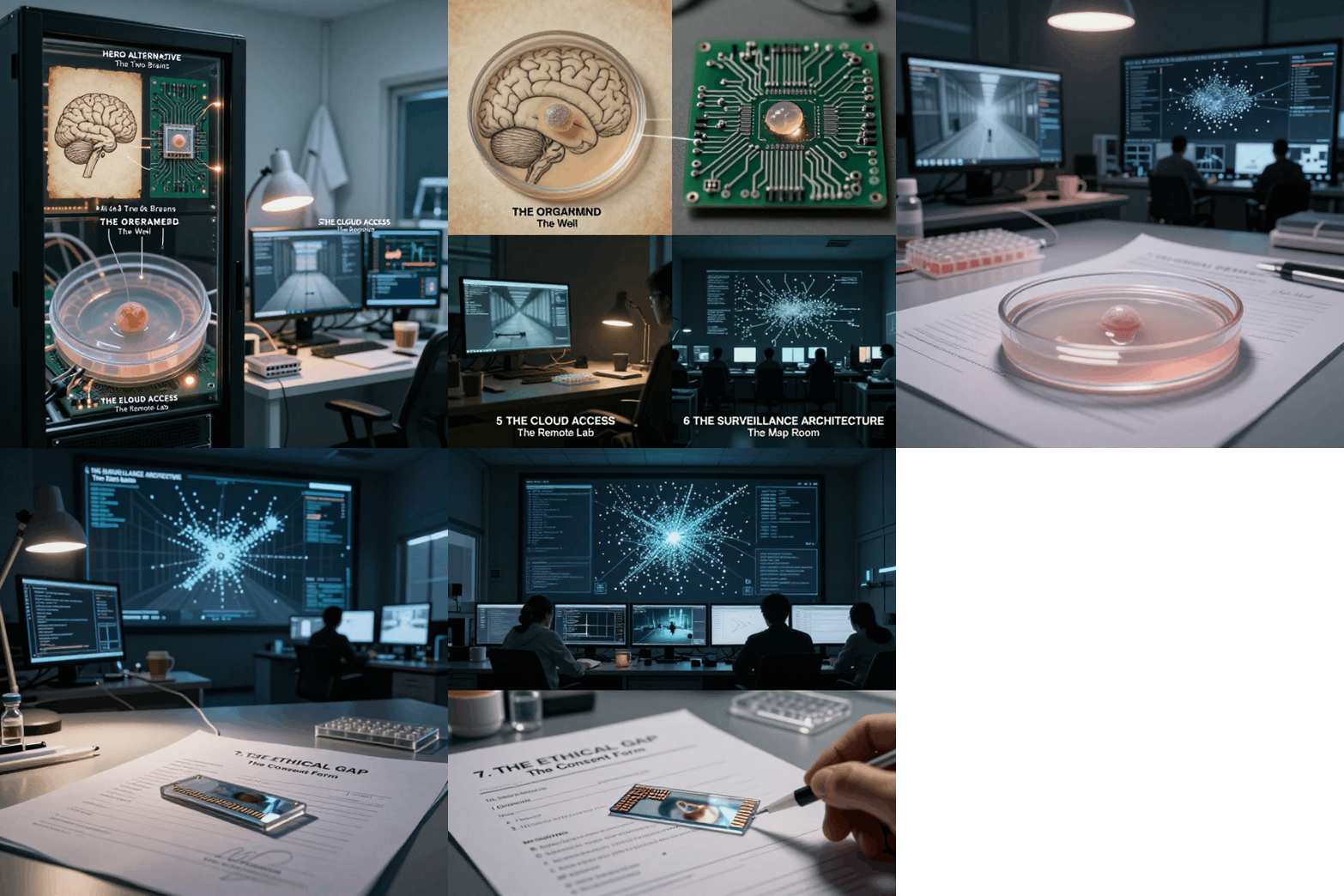
INTELLIGENCE DOSSIER — FRONTPAGE
THE LIVING RACK
Human Neurons, Palantir’s Architecture, and the Biocomputing Future That Is Already Being Built
“In science fiction, people have long lived with these ideas. When you start saying, ‘I will use a neuron as a little machine,’ it’s a different view of our own brain — and it makes you ask what we are.”
This is not a story about science fiction. It is a forensic anatomy of an industry that already exists: living human brain cells, cultured in labs, placed on microelectrode arrays, connected to computers, and marketed as computing infrastructure.
The headlines are familiar. In 2022, Cortical Labs got human and mouse neurons to play Pong. In 2026, 200,000 human neurons learned to play Doom in five days — without programming, only through electrical feedback. In Switzerland, FinalSpark has offered cloud access to living organoids since 2023; nine universities initially received free accounts. In Melbourne, the CL1, the first commercially available biocomputer, sits in a black server rack.
And then there is Palantir. Peter Thiel’s surveillance conglomerate, founded with seed capital from the CIA. The connection between Palantir and the biocomputing industry is not directly documented — Palantir does not build neurons. But the architecture Palantir provides is the architecture into which biological data would flow. Anyone who conducts surveillance and prediction over populations has a structural interest in every new data source. Living neurons that learn are a data source.
And a German author named Tom-Oliver Regenauer has repeatedly named exactly this connection — in books, podcasts, and articles describing Palantir as the “most powerful surveillance, espionage, big-data, and pre-crime management conglomerate of all time.” This dossier does not ask whether Regenauer is right. It asks: What is documented, what is inference, and what does it mean when living brain cells become racks?
📊 THE RANKING — SIX NODES, DOCUMENTED ROLES
1 — Node: Cortical Labs and the CL1 (Melbourne, 2022–2026)
Function: Commercialization of biocomputers based on human neurons
Documented basis: The CL1 contains roughly 200,000 to 800,000 human neurons (figures diverge by source) on a silicon chip platform with microelectrodes. The neurons are derived from donor cells — CEO Hon Weng Chong extracted his own cells for the experiment. 2022: Pong. 2026: Doom, learned in about a week through electrical feedback. The CL1 is sold as a commercial product; buyers include a cryptocurrency company and researchers who want to control robots.
Evidence grade: A-1 (corporate communications, scientific publications, independent reporting)
2 — Node: FinalSpark and the Neuroplatform (Vevey, Switzerland, 2023–2026)
Function: Cloud access to living brain organoids
Documented basis: Since 2023, FinalSpark has offered remote access to living organoids via an API. Users can write Python code to stimulate neurons and read their activity. The organoids are produced from induced pluripotent stem cells derived from human skin cells, sourced from a Japanese clinic; donors are anonymous. Organoids can survive up to four months.
Evidence grade: A-1 (BBC on-site visit, corporate communications)
3 — Node: The Energy-Efficiency Claim
Function: The central sales argument — and the biggest open question
Documented basis: Cortical cites roughly 25 watts per CL1 unit and 800 to 1,000 watts per rack. The human brain operates at about 20 watts. But independent analysts point out that these figures are incomplete: pumps, temperature control, gas management, filtration, and life-support systems are missing from the balance. A comparison with silicon under identical workload has not been published.
Evidence grade: B-2 (claim documented; independent verification absent)
4 — Node: The Ethical Governance Gap
Function: The industry’s blind spot
Documented basis: The International Society for Stem Cell Research states that there is currently “no biological evidence for consciousness or pain perception” in organoids. But a 2026 governance audit argued that Cortical and FinalSpark have not published publicly accessible documentation on donor consent, ethics structures, termination protocols, or data governance. Cortical disputed this, stating such structures exist internally. Both positions can be true — and that is precisely the problem: safeguards can exist without being externally verifiable.
Evidence grade: B-1 (governance audit public; internal counter-position documented)
5 — Node: Palantir and the Data Architecture
Function: The surveillance infrastructure into which biological data could flow
Documented basis: Palantir was founded in 2003 by Peter Thiel, with $2 million in seed capital from In-Q-Tel, the CIA’s venture arm. Clients: CIA, FBI, NSA, DHS, IRS, Marines, Air Force, Morgan Stanley, Airbus, United Nations. Contracts with ICE for “complete target analysis of known populations.” Collaboration with the IDF on surveillance and targeting technologies.
Evidence grade: A-1 for the documented contracts and funding; B-2 for the inference of a direct connection to the biocomputing industry
6 — Node: Tom-Oliver Regenauer and the Documented Warning
Function: The German author who publicly named the connection between Palantir, neurotechnology, and control
Documented basis: Regenauer describes Palantir as “the most powerful surveillance, espionage, big-data, and pre-crime management conglomerate of all time.” In his blog and interviews, he connects Palantir with neurotechnology, nanobots, and “cognitive warfare.” His book “Die Dunkle Aufklärung” examines the “Thiel-Verse” and its philosophy. In an interview he explains that the structure for predictive policing already exists, and that anyone can become a “person of interest.”
Evidence grade: A-1 for the documented statements; B-2 for the analytical conclusions
Note on the ranking: ordered by documentary proximity to the core thesis. Cortical and FinalSpark are the documented biocomputing reality. Palantir is the documented surveillance architecture. Regenauer is the documented warning. The connection between them is inference, not proven fact — and precisely that makes it analytically relevant.
👤 BIOS — THE PEOPLE AND INSTITUTIONS
Hon Weng Chong — The Surgeon Who Grows Neurons
Role: CEO and co-founder of Cortical Labs
Key fact: Chong extracted his own cells for the Doom experiment. Asked why one would train a synthetic life form to shoot people, he replied: “In computer-nerd science land, there’s an obsession with making Doom run on everything. It’s cool.”
Background: Chong is a physician and entrepreneur. Cortical Labs has published more than a dozen peer-reviewed scientific papers — an unusual step for a startup selling a commercial product. The CL1 is the first commercially available biological computing system. Buyers range from cryptocurrency firms to students who want to play Doom.
Fred Jordan — The Cloud Provider for Living Brains
Role: Co-founder of FinalSpark, Vevey, Switzerland
Key fact: “In science fiction, people have long lived with these ideas. When you start saying, ‘I will use a neuron as a little machine,’ it’s a different view of our own brain — and it makes you ask what we are.”
Background: Jordan turned away from artificial neural networks because the results were “not convincing” and the energy bill too high. His pivot: “Maybe it’s a better idea to use real neurons.” FinalSpark has offered cloud access to organoids since 2023. The donors of the skin cells from which the stem cells are derived are anonymous.
Peter Thiel — The Architect of the Surveillance Infrastructure
Role: Co-founder of Palantir; chairman
Key fact: Palantir received $2 million in seed capital from In-Q-Tel, the CIA’s venture arm. Thiel is a declared anti-democrat and has publicly speculated about the apocalypse and the Antichrist.
Background: Thiel founded PayPal, then Palantir. In 2017 the Guardian noted that Palantir “has as much power in the real world as Google, Microsoft, Facebook, Amazon, and Apple” have in the digital one. Palantir is the most secretive of the tech conglomerates. Its software “Gotham” and “VeRa” is used by intelligence services, militaries, and law enforcement worldwide.
The inference: If Palantir aggregates data about populations and makes predictions about behaviour, then any new data source — including biological neurons that learn — is of structural interest. This is not a proven connection. It is a logical consequence of the architecture.
Tom-Oliver Regenauer — The Chronicler
Role: German author, journalist, podcaster
Key fact: Describes Palantir as “the most powerful surveillance, espionage, big-data, and pre-crime management conglomerate of all time.” In “Die Dunkle Aufklärung” he examines the “Thiel-Verse” and its philosophy. In interviews he warns of the structure of predictive policing in which “anyone can become a person of interest.”
Background: Regenauer is not a mainstream journalist. He publishes on alternative platforms and in publications outside the media consensus. That does not make his statements false — but it means his claims must be checked against primary documents, not against his credibility. The documented facts about Palantir’s funding, clients, and contracts are public. Regenauer’s achievement lies in placing them in a context often missing from mainstream coverage.
The documented warning: Regenauer publicly named the connection between surveillance capitalism and neurotechnology before it arrived in mainstream debate. Whether the connection is causal or parallel remains open. That it is structurally plausible is documented.
📁 THE DOCUMENTS — PRIMARY SOURCES
Cortical Labs — CL1 and Doom
Source: Science et Vie, Hindustan Times, Sydney Morning Herald, independent reporting — Access: Public
What the documents show: 200,000 human neurons on a chip with 22,000 microelectrodes. Doom learned in five days through electrical feedback, without programming. The CL1 is commercially available; buyers range from crypto firms to students. The neurons come from donor cells, including those of the CEO.
FinalSpark — Neuroplatform and Cloud Access
Source: BBC News Mundo — Access: Public
What the document shows: Organoids from human skin cells, sourced from a Japanese clinic, donors anonymous. Survival up to four months. Cloud access via API; users write Python to stimulate neurons and read activity. Fred Jordan: “I give you access to my brain organoids.”
The Energy-Efficiency Claim — and Its Gaps
Source: The Wetware Age (Substack), analysis — Access: Public
What the document shows: Cortical cites 25 watts per CL1 and 800–1,000 watts per rack. But pumps, temperature control, gas management, filtration, and life support are missing from the balance. A comparison with silicon under identical workload has not been published. The neuron count diverges between sources: 800,000 (IEEE Spectrum) vs. 200,000 (NUS Medicine).
Governance Audit — The Consent Gap
Source: Nature (July 2026), SSRN audit (March 2026), ISSCR guidelines — Access: Public
What the documents show: Bioethicists warned in Nature that tissue donors may have no idea their cells could be used for biocomputers. A governance audit argued that Cortical and FinalSpark have published no publicly accessible documentation on consent, ethics structures, or termination protocols. Cortical disputed this: the structures exist internally. The ISSCR states there is currently no evidence of consciousness or pain in organoids — but warns this could change with increasing complexity.
Palantir — Funding, Clients, Contracts
Source: Government records, investigative reporting, Regenauer analysis — Access: Public
What the documents show: $2 million in seed capital from In-Q-Tel (CIA). Clients: CIA, FBI, NSA, DHS, IRS, Marines, Air Force, Morgan Stanley, Airbus, UN. ICE contract for “complete target analysis of known populations.” IDF collaboration on surveillance and targeting technologies.
Regenauer — The Documented Warning
Source: regenauer.press, apolut.net, interviews — Access: Public
What the documents show: Palantir as the “most powerful surveillance conglomerate of all time.” The “Thiel-Verse” and its philosophy. The structure of predictive policing in which anyone can become a person of interest. The connection of neurotechnology and cognitive warfare.
🔒 SECRET CONCLUSIONS — WHAT THE FRONTPAGE CANNOT SAY
The following are analytical inferences drawn from the documented record. They are not assertions of fact. They are marked as inferences and should be tested against future disclosures.
1. The biocomputing industry is real, commercial, and growing — but its central claim is unproven.
Cortical and FinalSpark sell access to living human neurons. That is documented. But the claim that these systems are more energy-efficient than silicon has not been independently verified. The published figures omit the life-support systems. This is not fraud — it is an incomplete balance sheet. But it means the efficiency revolution being sold has not yet been demonstrated.
2. The governance gap is the real risk — not consciousness.
The debate over consciousness in organoids is important, but it is not the immediate threat. The immediate threat is more banal: donors of skin cells may not know their cells are being used for biocomputers. There is no publicly accessible documentation of what happens to organoids when they die, or who decides which experiments are conducted. The companies say the structures exist. But they are not verifiable. That is the governance problem.
3. Palantir does not build neurons — but the architecture of surveillance is the natural recipient of biological data.
There is no documented connection between Palantir and Cortical or FinalSpark. But Palantir’s business model is the aggregation of population data to predict behaviour. If living neurons learn, they are a data source. If biocomputers are commercialized, their outputs become data. The architecture that could absorb and exploit these data already exists. This is not a conspiracy. It is a structural consequence.
4. Regenauer named the connection before it became mainstream — and that is his analytical achievement.
Regenauer is not a neutral observer. He publishes in alternative circles and has a clear political position. But he publicly named the connection between surveillance capitalism, neurotechnology, and cognitive control before it arrived in mainstream debate. That does not make his statements true — but it makes them a documented date in the history of warnings. The question is not whether Regenauer is right. The question is whether the documented facts he cites support the conclusion he draws.
5. The “Doom” motif is not just a meme. It is a cultural signature.
Doom is the game in which a lone fighter kills demons. Running it on living human neurons is a technical feat — but it is also a symbolic act. The researchers say it is “cool.” Chong says it is a nerd obsession. But the choice of game is not neutral. It is a culture that codes violence as entertainment, applied to biological tissue. This is not an accusation. It is an observation.
🔓 THE FULL DOSSIER — PATREON EXCLUSIVE
The frontpage gives you the architecture. The Patreon deep dive gives you the blueprints:
- The complete biocomputing map: Cortical, FinalSpark, Brainoware — every institution, every funding source, every documented milestone
- The Palantir file: from In-Q-Tel to ICE — the documented funding and contract chain
- The Regenauer documentation: every statement, every text, every podcast — with source criticism and evidence grades
- Probability scenarios with the arithmetic shown: five models for the next 24 months
- The secret conclusions in full: the inferences that did not fit the frontpage format
Analyst tier and above.
🏆 PATREON MEMBERSHIP OPTIONS
- Supporter — €4.50/month: Access to exclusive content and more
- Analyst (Entry) — €9.00/month: Access to exclusive content and secret information
- Analyst (Most Popular) — €45.00/month: Exclusive content and research, secret information, research on demand
- Senior Analyst — €447.50/month: All above plus Above Top Secret content and research on demand
- Strategic / Above Top Secret — €886.00/month: All above plus dedicated censorship-free communication strategies and management
Individual Dossiers: €89.00 each.
“This is not commentary. This is the raw material — the files, the ledgers, the sealed records — plus my forensic analysis of what they actually mean.”
⬇️ DOWNLOAD LINKS FOR ORIGINAL DOCUMENTS
- Cortical Labs — CL1 and Doom — Source: Science et Vie, Hindustan Times, Sydney Morning Herald — Access: Public
- FinalSpark — Neuroplatform and Cloud Access — Source: BBC News Mundo — Access: Public
- The Energy-Efficiency Claim — Source: The Wetware Age — Access: Public
- Governance Audit — Source: Nature, SSRN, ISSCR — Access: Public
- Palantir — Funding and Contracts — Source: In-Q-Tel, government records — Access: Public
- Regenauer — Documented Warning — Source: regenauer.press, apolut.net — Access: Public
SECURE CONTACT CHANNELS
- YouTube — youtube.com/@bernd_pulch
- X (Twitter) — x.com/berndsocial1
- Telegram — t.me/ABOVETOPSECRETXXL
- Patreon — patreon.com/berndpulch
- Website — intelligenceoriginal.com
📝 METHODOLOGY & EDITORIAL STANDARD
Intelligence Original distinguishes between documented facts, reported information, and analytical interpretation. The existence of a biocomputer, a surveillance contract, or a warning is not in itself evidence of misconduct. Our analyses examine how structures operate and what effects they produce.
Sources for this dossier include: Science et Vie, Hindustan Times, Sydney Morning Herald, BBC News Mundo, The Wetware Age, Nature, SSRN, ISSCR, In-Q-Tel, government records, regenauer.press, apolut.net.
All published claims should be independently verified against primary documents. This platform publishes investigative research products. It does not provide investment, tax, or legal advice.
INTELLIGENCE DOSSIER — FRONTPAGE
THE LIVING RACK
Human Neurons, Palantir’s Architecture, and the Biocomputing Future That Is Already Being Built
„In der Science-Fiction leben die Menschen seit langem mit diesen Ideen. Wenn man anfängt zu sagen: ‚Ich werde ein Neuron als kleine Maschine benutzen’, ist das eine andere Sicht auf unser eigenes Gehirn — und es lässt einen fragen, was wir sind.”
Dies ist keine Geschichte über Science-Fiction. Es ist eine forensische Anatomie einer Industrie, die bereits existiert: lebende menschliche Gehirnzellen, gezüchtet in Labors, auf Mikroelektrodenarrays platziert, mit Computern verbunden und als Recheninfrastruktur vermarktet.
Die Schlagzeilen sind bekannt. Im Jahr 2022 brachte Cortical Labs menschliche und Maus-Neuronen dazu, Pong zu spielen [citation:7]. Im Jahr 2026 lernten 200.000 menschliche Neuronen in fünf Tagen, Doom zu spielen — ohne Programmierung, nur durch elektrische Rückmeldung [citation:3]. In der Schweiz bietet FinalSpark seit 2023 Cloud-Zugang zu lebenden Organoiden an; neun Universitäten erhielten zunächst kostenlose Konten [citation:10]. In Melbourne steht der CL1, der erste kommerziell erhältliche Biocomputer, in einem schwarzen Serverrack [citation:12].
Und dann ist da Palantir. Peter Thiels Überwachungskonzern, gegründet mit Startkapital der CIA [citation:26]. Die Verbindung zwischen Palantir und der Biocomputing-Industrie ist nicht direkt dokumentiert — Palantir baut keine Neuronen. Aber die Architektur, die Palantir bereitstellt, ist die Architektur, in die biologische Daten fließen würden. Wer Überwachung und Vorhersage über Populationen betreibt, hat ein strukturelles Interesse an jeder neuen Datenquelle. Lebende Neuronen, die lernen, sind eine Datenquelle.
Und ein deutscher Autor namens Tom-Oliver Regenauer hat genau diese Verbindung immer wieder benannt — in Büchern, Podcasts und Artikeln, die Palantir als das „mächtigste Überwachungs-, Spionage-, Big-Data- und Pre-Crime-Management-Konzern aller Zeiten” beschreiben [citation:26]. Dieses Dossier fragt nicht, ob Regenauer recht hat. Es fragt: Was ist dokumentiert, was ist Inferenz, und was bedeutet es, wenn lebende Gehirnzellen zu Racks werden?
📊 DAS RANKING — SECHS KNOTEN, DOKUMENTIERTE ROLLEN
1 — Knoten: Cortical Labs und der CL1 (Melbourne, 2022–2026)
Funktion: Kommerzialisierung von Biocomputern auf Basis menschlicher Neuronen
Dokumentierte Grundlage: Der CL1 enthält etwa 200.000 bis 800.000 menschliche Neuronen (die Zahlen divergieren je nach Quelle) auf einer Siliziumchip-Plattform mit Mikroelektroden [citation:6][citation:12]. Die Neuronen werden aus Spenderzellen gewonnen — CEO Hon Weng Chong entnahm eigene Zellen für das Experiment [citation:2]. 2022: Pong. 2026: Doom, erlernt in etwa einer Woche durch elektrische Rückmeldung [citation:3][citation:10]. Der CL1 wird als kommerzielles Produkt verkauft; Käufer sind unter anderem ein Kryptowährungsunternehmen und Forscher, die Roboter steuern wollen [citation:12].
Evidenzgrad: A-1 (Unternehmenskommunikation, wissenschaftliche Publikationen, unabhängige Berichterstattung)
2 — Knoten: FinalSpark und das Neuroplatform (Vevey, Schweiz, 2023–2026)
Funktion: Cloud-Zugang zu lebenden Gehirnorganoiden
Dokumentierte Grundlage: FinalSpark bietet seit 2023 Fernzugriff auf lebende Organoide über eine API. Nutzer können Python-Code schreiben, um Neuronen zu stimulieren und ihre Aktivität zu lesen [citation:10]. Die Organoide werden aus induzierten pluripotenten Stammzellen hergestellt, die aus menschlichen Hautzellen gewonnen und von einer japanischen Klinik bezogen werden; die Spender sind anonym [citation:5]. Die Organoide können bis zu vier Monate überleben [citation:5].
Evidenzgrad: A-1 (BBC-Besuch vor Ort, Unternehmenskommunikation)
3 — Knoten: Die Energieeffizienz-Behauptung
Funktion: Das zentrale Verkaufsargument — und die größte offene Frage
Dokumentierte Grundlage: Cortical gibt etwa 25 Watt pro CL1-Einheit und 800 bis 1.000 Watt pro Rack an [citation:6]. Das menschliche Gehirn arbeitet mit etwa 20 Watt [citation:11]. Aber unabhängige Analysten weisen darauf hin, dass diese Zahlen unvollständig sind: Pumpen, Temperaturkontrolle, Gasmanagement, Filtration und Lebenserhaltungssysteme fehlen in der Bilanz [citation:6]. Ein Vergleich mit Silizium unter identischer Arbeitslast wurde nicht veröffentlicht.
Evidenzgrad: B-2 (Behauptung dokumentiert; unabhängige Verifikation fehlt)
4 — Knoten: Die ethische Governance-Lücke
Funktion: Der blinde Fleck der Industrie
Dokumentierte Grundlage: Die International Society for Stem Cell Research stellt fest, dass es derzeit „keine biologischen Belege für Bewusstsein oder Schmerzwahrnehmung” bei Organoiden gibt [citation:6]. Aber eine Governance-Prüfung von 2026 argumentierte, dass Cortical und FinalSpark keine öffentlich einsehbaren Dokumentationen zu Spender-Einwilligung, Ethikstrukturen, Stilllegungsprotokollen oder Datengovernance veröffentlicht haben [citation:6]. Cortical widersprach und erklärte, solche Strukturen existierten intern. Beide Positionen können wahr sein — und genau das ist das Problem: Sicherheitsvorkehrungen können existieren, ohne von außen prüfbar zu sein.
Evidenzgrad: B-1 (Governance-Audit öffentlich; interne Gegenposition dokumentiert)
5 — Knoten: Palantir und die Datenarchitektur
Funktion: Die Überwachungsinfrastruktur, in die biologische Daten potenziell fließen
Dokumentierte Grundlage: Palantir wurde 2003 von Peter Thiel gegründet, mit 2 Millionen Dollar Startkapital von In-Q-Tel, dem Venture-Arm der CIA [citation:26]. Kunden: CIA, FBI, NSA, DHS, IRS, Marines, Air Force, Morgan Stanley, Airbus, Vereinte Nationen [citation:26]. Verträge mit ICE für „complete target analysis of known populations” [citation:2]. Zusammenarbeit mit der IDF an Überwachungs- und Zieltechnologien [citation:2].
Evidenzgrad: A-1 für die dokumentierten Verträge und die Finanzierung; B-2 für die Inferenz einer direkten Verbindung zur Biocomputing-Industrie
6 — Knoten: Tom-Oliver Regenauer und die dokumentierte Warnung
Funktion: Der deutsche Autor, der die Verbindung zwischen Palantir, Neurotechnologie und Kontrolle öffentlich benannt hat
Dokumentierte Grundlage: Regenauer beschreibt Palantir als „das mächtigste Überwachungs-, Spionage-, Big-Data- und Pre-Crime-Management-Konzern aller Zeiten” [citation:26]. In seinem Blog und in Interviews verbindet er Palantir mit Neurotechnologie, Nanobots und „kognitiver Kriegsführung” [citation:16][citation:19]. Sein Buch „Die Dunkle Aufklärung” untersucht das „Thiel-Verse” und dessen Philosophie [citation:21]. In einem Interview erklärt er, die Struktur für prädiktive Polizeiarbeit existiere bereits, und jeder könne zum „Gefährder” werden [citation:20].
Evidenzgrad: A-1 für die dokumentierten Aussagen; B-2 für die analytischen Schlussfolgerungen
Hinweis zum Ranking: geordnet nach dokumentarischer Nähe zur Kernthese. Cortical und FinalSpark sind die dokumentierte Biocomputing-Realität. Palantir ist die dokumentierte Überwachungsarchitektur. Regenauer ist die dokumentierte Warnung. Die Verbindung zwischen ihnen ist Inferenz, nicht bewiesene Tatsache — und genau das macht sie analytisch relevant.
👤 BIOGRAFIEN — DIE MENSCHEN UND INSTITUTIONEN
Hon Weng Chong — Der Chirurg, der Neuronen züchtet
Rolle: CEO und Mitbegründer von Cortical Labs
Schlüsselfakt: Chong entnahm eigene Zellen für das Doom-Experiment. Auf die Frage, warum man eine synthetische Lebensform trainiert, Menschen zu erschießen, antwortete er: „Im Computer-Nerd-Wissenschaftsland gibt es eine Besessenheit davon, Doom auf allem zum Laufen zu bringen. Es ist cool.” [citation:2]
Hintergrund: Chong ist Arzt und Unternehmer. Cortical Labs hat mehr als ein Dutzend grundlegende wissenschaftliche Arbeiten veröffentlicht — ein ungewöhnlicher Schritt für ein Startup, das ein kommerzielles Produkt verkauft [citation:12]. Der CL1 ist das erste kommerziell erhältliche biologische Computersystem. Die Käufer reichen von Kryptowährungsfirmen bis zu Studenten, die Doom spielen wollen.
Fred Jordan — Der Cloud-Anbieter für lebende Gehirne
Rolle: Mitbegründer von FinalSpark, Vevey, Schweiz
Schlüsselfakt: „In der Science-Fiction leben die Menschen seit langem mit diesen Ideen. Wenn man anfängt zu sagen: ‚Ich werde ein Neuron als kleine Maschine benutzen’, ist das eine andere Sicht auf unser eigenes Gehirn — und es lässt einen fragen, was wir sind.” [citation:5]
Hintergrund: Jordan wandte sich von künstlichen neuronalen Netzen ab, weil die Ergebnisse „nicht überzeugend” waren und die Energierechnung zu hoch. Sein Pivot: „Vielleicht ist es eine bessere Idee, echte Neuronen zu verwenden.” [citation:10] FinalSpark bietet seit 2023 Cloud-Zugang zu Organoiden. Die Spender der Hautzellen, aus denen die Stammzellen gewonnen werden, sind anonym.
Peter Thiel — Der Architekt der Überwachungsinfrastruktur
Rolle: Mitbegründer von Palantir; Vorsitzender
Schlüsselfakt: Palantir erhielt 2 Millionen Dollar Startkapital von In-Q-Tel, dem CIA-Venture-Arm [citation:26]. Thiel ist ein erklärter Anti-Demokrat und hat öffentlich über die Apokalypse und den Antichristen spekuliert [citation:2].
Hintergrund: Thiel gründete PayPal, dann Palantir. Der Guardian attestierte Palantir 2017, „genauso viel Macht in der realen Welt zu haben wie Google, Microsoft, Facebook, Amazon und Apple” in der digitalen [citation:26]. Palantir ist der verschwiegenste unter den Tech-Konzernen. Seine Software „Gotham” und „VeRa” werden von Geheimdiensten, Militär und Strafverfolgung weltweit eingesetzt.
Die Inferenz: Wenn Palantir Daten über Populationen aggregiert und Vorhersagen über Verhalten trifft, dann ist jede neue Datenquelle — einschließlich biologischer Neuronen, die lernen — von strukturellem Interesse. Dies ist keine bewiesene Verbindung. Es ist eine logische Konsequenz der Architektur.
Tom-Oliver Regenauer — Der Chronist
Rolle: Deutscher Autor, Journalist, Podcaster
Schlüsselfakt: Beschreibt Palantir als „das mächtigste Überwachungs-, Spionage-, Big-Data- und Pre-Crime-Management-Konzern aller Zeiten” [citation:26]. In „Die Dunkle Aufklärung” untersucht er das „Thiel-Verse” und dessen Philosophie [citation:21]. In Interviews warnt er vor der Struktur prädiktiver Polizeiarbeit, in der „jeder zum Gefährder werden kann” [citation:20].
Hintergrund: Regenauer ist kein Mainstream-Journalist. Er publiziert auf alternativen Plattformen und in Publikationen, die außerhalb des medialen Konsenses stehen. Das macht seine Aussagen nicht falsch — aber es bedeutet, dass seine Behauptungen gegen Primärdokumente geprüft werden müssen, nicht gegen seine Glaubwürdigkeit. Die dokumentierten Fakten über Palantirs Finanzierung, Kunden und Verträge sind öffentlich. Regenauers Leistung besteht darin, sie in einen Zusammenhang zu stellen, der in der Mainstream-Berichterstattung oft fehlt.
Die dokumentierte Warnung: Regenauer hat die Verbindung zwischen Überwachungskapitalismus und Neurotechnologie öffentlich benannt, bevor sie in der Mainstream-Debatte angekommen ist. Ob die Verbindung kausal ist oder parallel, bleibt offen. Dass sie strukturell plausibel ist, ist dokumentiert.
📁 DIE DOKUMENTE — PRIMÄRQUELLEN
Cortical Labs — CL1 und Doom
Quelle: Science et Vie, Hindustan Times, Sydney Morning Herald, unabhängige Berichterstattung — Zugang: Öffentlich
Was die Dokumente zeigen: 200.000 menschliche Neuronen auf einem Chip mit 22.000 Mikroelektroden. Doom erlernt in fünf Tagen durch elektrische Rückmeldung, ohne Programmierung. Der CL1 ist kommerziell erhältlich; Käufer reichen von Kryptofirmen bis zu Studenten. Die Neuronen stammen aus Spenderzellen, einschließlich denen des CEO [citation:2][citation:3][citation:12].
FinalSpark — Neuroplatform und Cloud-Zugang
Quelle: BBC News Mundo — Zugang: Öffentlich
Was das Dokument zeigt: Organoide aus menschlichen Hautzellen, bezogen von einer japanischen Klinik, Spender anonym. Überleben bis zu vier Monate. Cloud-Zugang über API; Nutzer schreiben Python, um Neuronen zu stimulieren und Aktivität zu lesen. Fred Jordan: „Ich gebe Ihnen Zugang zu meinen Gehirnorganoiden.” [citation:5][citation:10]
Die Energieeffizienz-Behauptung — und ihre Lücken
Quelle: The Wetware Age (Substack), Analyse — Zugang: Öffentlich
Was das Dokument zeigt: Cortical gibt 25 Watt pro CL1 und 800–1.000 Watt pro Rack an. Aber Pumpen, Temperaturkontrolle, Gasmanagement, Filtration und Lebenserhaltung fehlen in der Bilanz. Ein Vergleich mit Silizium unter identischer Arbeitslast wurde nicht veröffentlicht. Die Neuronenzahl divergiert zwischen Quellen: 800.000 (IEEE Spectrum) vs. 200.000 (NUS Medicine) [citation:6].
Governance-Audit — Die Einwilligungslücke
Quelle: Nature (Juli 2026), SSRN-Audit (März 2026), ISSCR-Leitlinien — Zugang: Öffentlich
Was die Dokumente zeigen: Bioethiker warnten in Nature, dass Gewebespender möglicherweise keine Ahnung haben, dass ihre Zellen für Biocomputer verwendet werden könnten. Ein Governance-Audit argumentierte, Cortical und FinalSpark hätten keine öffentlich einsehbaren Dokumentationen zu Einwilligung, Ethikstrukturen oder Stilllegungsprotokollen. Cortical widersprach: Die Strukturen existierten intern. Die ISSCR stellt fest, dass es derzeit keine Belege für Bewusstsein oder Schmerz bei Organoiden gibt — warnt aber, dass sich dies mit zunehmender Komplexität ändern könnte [citation:6].
Palantir — Finanzierung, Kunden, Verträge
Quelle: Regierungsunterlagen, investigative Berichterstattung, Regenauer-Analyse — Zugang: Öffentlich
Was die Dokumente zeigen: 2 Millionen Dollar Startkapital von In-Q-Tel (CIA). Kunden: CIA, FBI, NSA, DHS, IRS, Marines, Air Force, Morgan Stanley, Airbus, UN. ICE-Vertrag für „complete target analysis of known populations”. IDF-Zusammenarbeit an Überwachungs- und Zieltechnologien [citation:2][citation:26].
Regenauer — Die dokumentierte Warnung
Quelle: regenauer.press, apolut.net, Interviews — Zugang: Öffentlich
Was die Dokumente zeigen: Palantir als „mächtigster Überwachungskonzern aller Zeiten”. Das „Thiel-Verse” und seine Philosophie. Die Struktur prädiktiver Polizeiarbeit, in der jeder zum Gefährder werden kann. Die Verbindung von Neurotechnologie und kognitiver Kriegsführung [citation:19][citation:20][citation:21].
🔒 GEHEIME SCHLUSSFOLGERUNGEN — WAS DIE TITELSEITE NICHT SAGEN KANN
Das Folgende sind analytische Schlüsse aus der dokumentierten Akte. Sie sind keine Tatsachenbehauptungen. Sie sind als Schlüsse markiert und sollten gegen künftige Offenlegungen getestet werden.
1. Die Biocomputing-Industrie ist real, kommerziell und wächst — aber ihre zentrale Behauptung ist unbewiesen.
Cortical und FinalSpark verkaufen Zugang zu lebenden menschlichen Neuronen. Das ist dokumentiert. Aber die Behauptung, dass diese Systeme energieeffizienter seien als Silizium, ist nicht unabhängig verifiziert. Die veröffentlichten Zahlen lassen die Lebenserhaltungssysteme aus. Das ist kein Betrug — es ist eine unvollständige Bilanz. Aber es bedeutet, dass die Effizienzrevolution, die verkauft wird, noch nicht demonstriert wurde [citation:6].
2. Die Governance-Lücke ist das eigentliche Risiko — nicht das Bewusstsein.
Die Debatte über Bewusstsein in Organoiden ist wichtig, aber sie ist nicht die unmittelbare Bedrohung. Die unmittelbare Bedrohung ist banaler: Spender von Hautzellen wissen möglicherweise nicht, dass ihre Zellen für Biocomputer verwendet werden. Es gibt keine öffentlich einsehbare Dokumentation darüber, was mit den Organoiden passiert, wenn sie sterben, oder wer entscheidet, welche Experimente durchgeführt werden. Die Unternehmen sagen, die Strukturen existierten. Aber sie sind nicht prüfbar. Das ist das Governance-Problem [citation:6].
3. Palantir baut keine Neuronen — aber die Architektur der Überwachung ist die natürliche Empfängerin biologischer Daten.
Es gibt keine dokumentierte Verbindung zwischen Palantir und Cortical oder FinalSpark. Aber Palantirs Geschäftsmodell ist die Aggregation von Daten über Populationen zur Vorhersage von Verhalten. Wenn lebende Neuronen lernen, sind sie eine Datenquelle. Wenn Biocomputer kommerzialisiert werden, werden ihre Outputs Daten. Die Architektur, die diese Daten aufnehmen und verwerten könnte, existiert bereits. Das ist keine Verschwörung. Es ist eine strukturelle Konsequenz [citation:26].
4. Regenauer hat die Verbindung benannt, bevor sie mainstream wurde — und das ist seine analytische Leistung.
Regenauer ist kein neutraler Beobachter. Er publiziert in alternativen Kreisen und hat eine klare politische Position. Aber er hat die Verbindung zwischen Überwachungskapitalismus, Neurotechnologie und kognitiver Kontrolle öffentlich benannt, bevor sie in der Mainstream-Debatte ankam. Das macht seine Aussagen nicht wahr — aber es macht sie zu einem dokumentierten Datum in der Geschichte der Warnungen. Die Frage ist nicht, ob Regenauer recht hat. Die Frage ist, ob die dokumentierten Fakten, die er zitiert, die Schlussfolgerung stützen, die er zieht [citation:20][citation:26].
5. Das „Doom”-Motiv ist nicht nur ein Meme. Es ist eine kulturelle Signatur.
Doom ist das Spiel, in dem ein einzelner Kämpfer Dämonen tötet. Es auf lebenden menschlichen Neuronen laufen zu lassen, ist ein technisches Kunststück — aber es ist auch eine symbolische Handlung. Die Forscher sagen, es sei „cool”. Chong sagt, es sei eine Nerd-Besessenheit. Aber die Wahl des Spiels ist nicht neutral. Es ist eine Kultur, die Gewalt als Unterhaltung kodiert, die auf biologisches Gewebe trifft. Das ist keine Anklage. Es ist eine Beobachtung [citation:2][citation:3].
🔓 DAS VOLLSTÄNDIGE DOSSIER — PATREON EXKLUSIV
Die Titelseite gibt Ihnen die Architektur. Der Patreon-Deep-Dive gibt Ihnen die Blaupausen:
- Die vollständige Biocomputing-Karte: Cortical, FinalSpark, Brainoware — jede Institution, jede Finanzierung, jeder dokumentierte Meilenstein
- Die Palantir-Akte: Von In-Q-Tel bis ICE — die dokumentierte Finanzierungs- und Vertragskette
- Die Regenauer-Dokumentation: Jede Aussage, jeder Text, jeder Podcast — mit Quellenkritik und Evidenzgraden
- Wahrscheinlichkeitsszenarien mit offengelegter Rechnung: fünf Modelle für die nächsten 24 Monate
- Die geheimen Schlussfolgerungen in voller Länge: die Schlüsse, die nicht ins Titelseitenformat passten
Analyst-Stufe und höher.
🏆 PATREON-MITGLIEDSCHAFTSOPTIONEN
- Supporter — 4,50 €/Monat: Zugang zu exklusiven Inhalten und mehr
- Analyst (Entry) — 9,00 €/Monat: Zugang zu exklusiven Inhalten und geheimen Informationen
- Analyst (Am beliebtesten) — 45,00 €/Monat: Exklusive Inhalte und Recherchen, geheime Informationen, Recherche auf Anfrage
- Senior Analyst — 447,50 €/Monat: Alles oben Genannte plus Above-Top-Secret-Inhalte und Recherche auf Anfrage
- Strategic / Above Top Secret — 886,00 €/Monat: Alles oben Genannte plus dedizierte zensurfreie Kommunikationsstrategien und -management
Einzeldossiers: 89,00 € pro Stück.
„Dies ist kein Kommentar. Dies ist das Rohmaterial — die Akten, die Ledger, die versiegelten Aufzeichnungen — plus meine forensische Analyse dessen, was sie tatsächlich bedeuten.”
⬇️ DOWNLOAD-LINKS FÜR ORIGINALDOKUMENTE
- Cortical Labs — CL1 und Doom — Quelle: Science et Vie, Hindustan Times, Sydney Morning Herald — Zugang: Öffentlich
- FinalSpark — Neuroplatform und Cloud-Zugang — Quelle: BBC News Mundo — Zugang: Öffentlich
- Die Energieeffizienz-Behauptung — Quelle: The Wetware Age — Zugang: Öffentlich
- Governance-Audit — Quelle: Nature, SSRN, ISSCR — Zugang: Öffentlich
- Palantir — Finanzierung und Verträge — Quelle: In-Q-Tel, Regierungsunterlagen — Zugang: Öffentlich
- Regenauer — Dokumentierte Warnung — Quelle: regenauer.press, apolut.net — Zugang: Öffentlich
SICHERE KONTAKTKANÄLE
- YouTube — youtube.com/@bernd_pulch
- X (Twitter) — x.com/berndsocial1
- Telegram — t.me/ABOVETOPSECRETXXL
- Patreon — patreon.com/berndpulch
- Website — intelligenceoriginal.com
📝 METHODIK & REDAKTIONELLER STANDARD
Intelligence Original unterscheidet zwischen dokumentierten Fakten, berichteten Informationen und analytischer Interpretation. Die Existenz eines Biocomputers, eines Überwachungsvertrags oder einer Warnung ist für sich genommen kein Beweis für Fehlverhalten. Unsere Analysen prüfen, wie Strukturen operieren und welche Wirkungen sie erzeugen.
Quellen für dieses Dossier umfassen: Science et Vie, Hindustan Times, Sydney Morning Herald, BBC News Mundo, The Wetware Age, Nature, SSRN, ISSCR, In-Q-Tel, Regierungsunterlagen, regenauer.press, apolut.net.
Alle veröffentlichten Behauptungen sollten unabhängig gegen Primärdokumente verifiziert werden. Diese Plattform veröffentlicht investigative Rechercheprodukte. Sie bietet keine Anlage-, Steuer- oder Rechtsberatung.
Leave a Reply